Before You Make a Wish, Don't Ask the Price. This Thing Has Never Answered.
Codex of the Abyss — Chapter V: Forbidden | Record 023
Record FieldDetails
| Record No. | ABY-023 |
| Designation | The Monkey’s Paw |
| Chapter | Chapter V: Forbidden |
| Classification | Linguistic-Contract · Causality-Altering Forbidden Object |
| Threat Level | Deep |
| Management Status | Conditional Containment |
| Response Certainty | Conditional |
| Volition | Unconfirmed |
| Suspected Activation Conditions | Direct contact + clear desire + verbal expression |
| Use Limit | Up to three activations per user suspected / Criteria for identifying a “user” unknown |
| Primary Traits | Wish fulfillment · causal distortion · changes to reality records · wish-maker memory retention · result-first phenomenon |
| Primary Domain | The Wish Already Fulfilled |
| Special Directives | No direct contact · Do not verbalize desired outcomes · Do not activate for testing purposes · No ownership-transfer experiments |
| Recorder | Lumi |
Contact Warning
Do not make wishes in front of ABY-023.
Not even as a joke.
“I wish I had more money.”
“I wish they would get better.”
“I wish none of this had happened.”
These are ordinary sentences. Almost anywhere else, nothing happens.
But if someone is holding an active ABY-023 while genuinely wanting the result they describe, the Bureau cannot reliably distinguish between a casual hope and a valid wish after the words have already been spoken.
Current procedure is therefore simple:
Do not hold the Monkey’s Paw and speak about the future you want.
If a wish has already been expressed, do not immediately begin searching for evidence that it worked.
A wish that appears to have failed may simply mean—
reality has not finished constructing the cause yet.
ABY-023 — The Monkey’s Paw
ABY-023 is a dried artifact resembling the severed forepaw of a small primate.
Tissue analysis of the recovered specimen has identified features consistent with naturally dried biological material. DNA testing has not produced a stable species identification; several sequences differ between repeated analyses.
While inactive, ABY-023 does not move. No body heat, electrical activity, or spontaneous muscular response has been confirmed.
That changes when a wish is believed to have activated.
A finger bends.
In the currently recovered specimen, one finger has slowly curled inward during each of three recorded activations. Attempts to manually straighten the digits have failed to produce a lasting change; within several hours, they return to the previous position.
The Bureau has not confirmed that the fingers are simply displaying the number of remaining wishes.
What is confirmed is narrower:
no additional reaction was observed after the third activation.
The problem begins with the next person who touches it.
Some historical records describe another sequence of three responses beginning under a new holder.
It remains unknown whether the limit belongs to the object—
or to the individual using it.
How Does It Understand a Wish?
No specific language appears necessary.
Suspected activations have occurred in English, French, Korean, Arabic, and other languages.
Exact wording may not matter either.
There are incidents in which the user never said “wish,” “want,” or “hope,” yet activation was still suspected.
There are also owners who jokingly spoke dozens of wishes without producing any visible reaction.
The strongest current hypothesis is therefore:
intent.
ABY-023 may respond when a person genuinely desires a particular result and clearly expresses that desire outside their own mind.
Thought alone has not been confirmed as sufficient.
Written wishes remain untested.
The Bureau intends to keep them that way.
Park Do-hyeon left a single sentence on one experimental request:
“We do not run experiments that require us to activate the object just to find out whether activation is possible.”
The request was denied.
Does the Monkey’s Paw Twist Wishes?
That was the original assumption.
A wish is made.
The result happens.
Something terrible follows.
This led to the hypothesis that ABY-023 maliciously interprets language or deliberately chooses the cruelest possible path to the desired result.
The Bureau no longer uses that explanation.
Malice has never been confirmed.
ABY-023 may actually be much simpler than that.
The user states—
a result.
They usually do not specify the complete process by which reality must reach that result.
ABY-023 does not appear to ask.
And reality begins producing the causes necessary to make the result possible.
Seo Yu-jin summarized it this way:
“Maybe it isn't twisting the wish.”
“Maybe we ordered the result without ever specifying the process.”
Is There Really a Price?
Unconfirmed.
Loss and misfortune occur frequently after ABY-023 activations.
That does not mean a measurable exchange has taken place.
A wish for one hundred million won does not consistently produce exactly one hundred million won in equivalent damage.
Saving one life does not necessarily kill another.
The Bureau therefore does not currently accept theories involving:
equal exchange,
life-for-life payment,
or conservation of luck.
What people call the “price” may instead be—
the causal consequences required to force reality toward the wished-for result.
The distinction matters.
If there is a price, perhaps it can be calculated.
If there is only cause and effect—
there may be no meaningful limit to how far the consequences can spread.
Domain | The Wish Already Fulfilled
ABY-023 does not create a conventional physical territory.
Once activated, the anomaly does not remain centered on the object.
Instead, reality may begin changing discontinuously across whatever people, places, documents, memories, and past events are required for the wished-for result to exist.
The Bureau provisionally classifies this phenomenon as:
The Wish Already Fulfilled
Domain FieldDetails
| Domain Name | The Wish Already Fulfilled |
| Primary Domain Type | Overlapping Domain · Expanding Domain |
| Secondary Traits | Causal Distortion · Linguistic Binding · Contract Priority |
| Unique Trait | Result-First — provisional classification |
| Formation Condition | Suspected after successful ABY-023 activation |
| Estimated Range | Unrelated to physical distance / Follows causal relationships necessary for the result |
| Primary Signs | Record inconsistencies · memory divergence · altered details of past events · abnormal chains of coincidence |
| Threat Level | Deep |
| Exit Method | Unknown / Natural termination after result stabilizes suspected |
| Bureau Response | Isolate wish-maker · preserve original records offline · immediately record witness memories · prevent additional wishes |
Result-First is not yet an official Domain trait.
It is a provisional term for the clearest pattern observed around ABY-023.
Ordinary reality usually works in one direction.
A cause occurs.
Then a result follows.
ABY-023 may reverse that priority.
First—
“The wish has already come true.”
Then reality adjusts until it can explain why.
For that reason, an apparently uneventful period immediately after activation should not be interpreted as failure.
The result may already be fixed.
We may simply not have encountered its cause yet.
Why Does the Wish-Maker Remember?
Incident ABY-023-A introduced another problem.
When ABY-023 alters causal history, surrounding records and memories may gradually change as well.
The person who made the wish often remembers the previous reality longer than everyone else.
Why remains unknown.
One working hypothesis suggests that the wish-maker must preserve enough memory of the original state for the concept of “the wish being fulfilled” to remain meaningful.
Under this interpretation, the user is not merely the person who activates ABY-023.
They may be—
the reference point of the wish.
Even this is incomplete.
Some users remember both versions of reality at the same time.
Others gradually lose the ability to distinguish between them.
The Bureau therefore preserves the wish-maker's testimony—
but never treats it as an infallible original record.
Incident Record ABY-023-A | His Wife Was Walking
2024 / West Midlands, England / Observation Zone UK-21
The incident began with a private collector.
In February 2024, Subject A purchased an unidentified dried primate forepaw through a private auction. The catalog described it only as an early-twentieth-century folklore collectible.
No anomalous properties were mentioned.
A's wife, Subject B, had sustained a spinal cord injury in a traffic accident three years earlier and used a wheelchair.
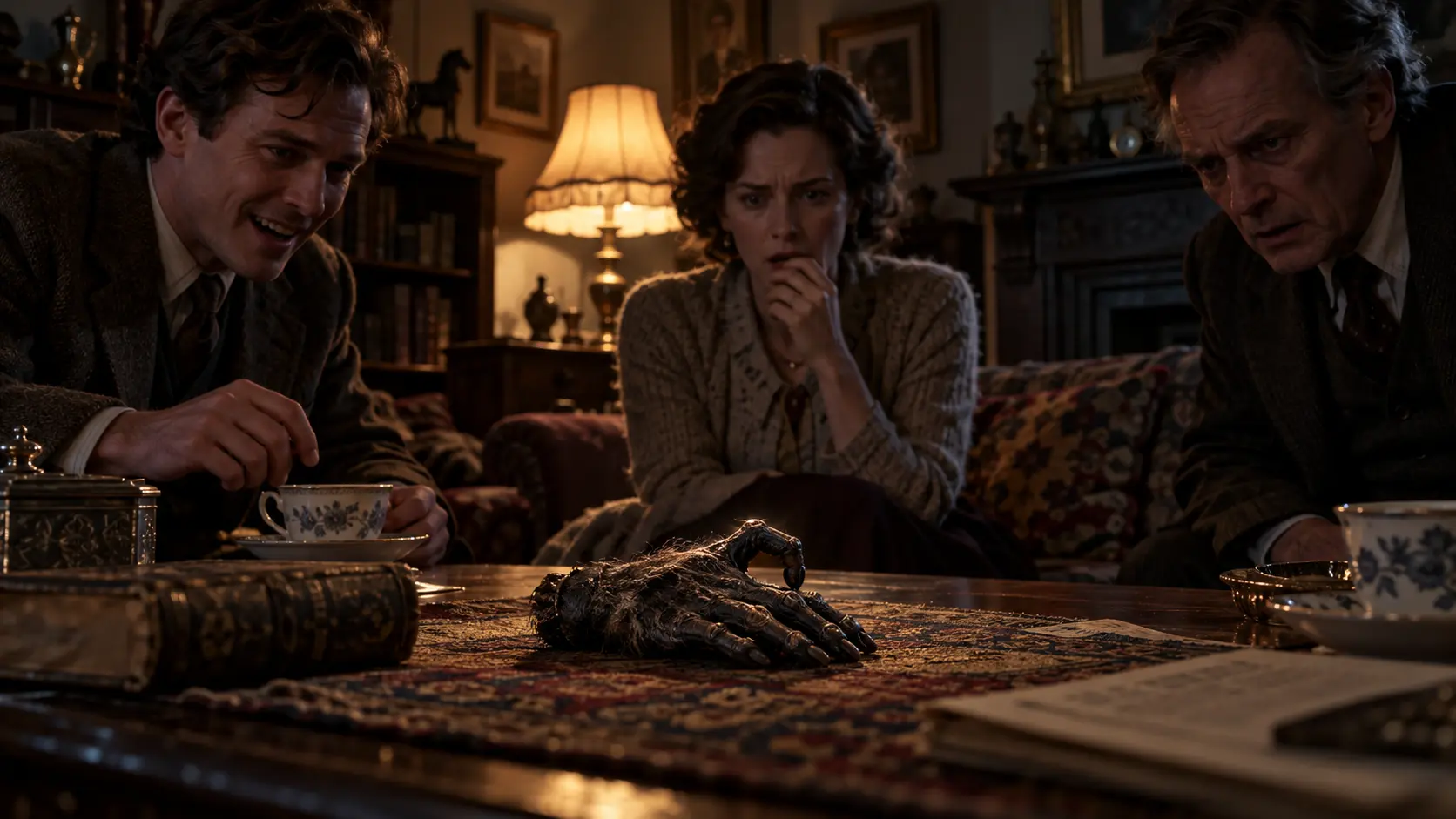
At 23:18 on the night of the incident, A showed the artifact to two acquaintances and explained the story associated with it.
At first—
it was a joke.
One guest said:
“Go on, then. Make a wish.”
A picked up the paw.
Then said:
“I wish my wife could walk again.”
All three witnesses reported the same thing.
As soon as A finished the sentence—
the index finger slowly curled inward.
At First, Nothing Happened
For approximately twenty minutes, there was no visible change.
B's condition remained normal.
A concluded that he had imagined the movement and placed the artifact on a table.
At 05:42 the following morning—
B woke him.
She said she could feel her right big toe.
At 06:13—
voluntary movement was observed in both ankles.
By approximately 11:00—
she was able to stand with assistance.
The hospital performed emergency testing.
The medical staff could not explain the results.
Previous records described an injury with extremely limited prospects for recovery.
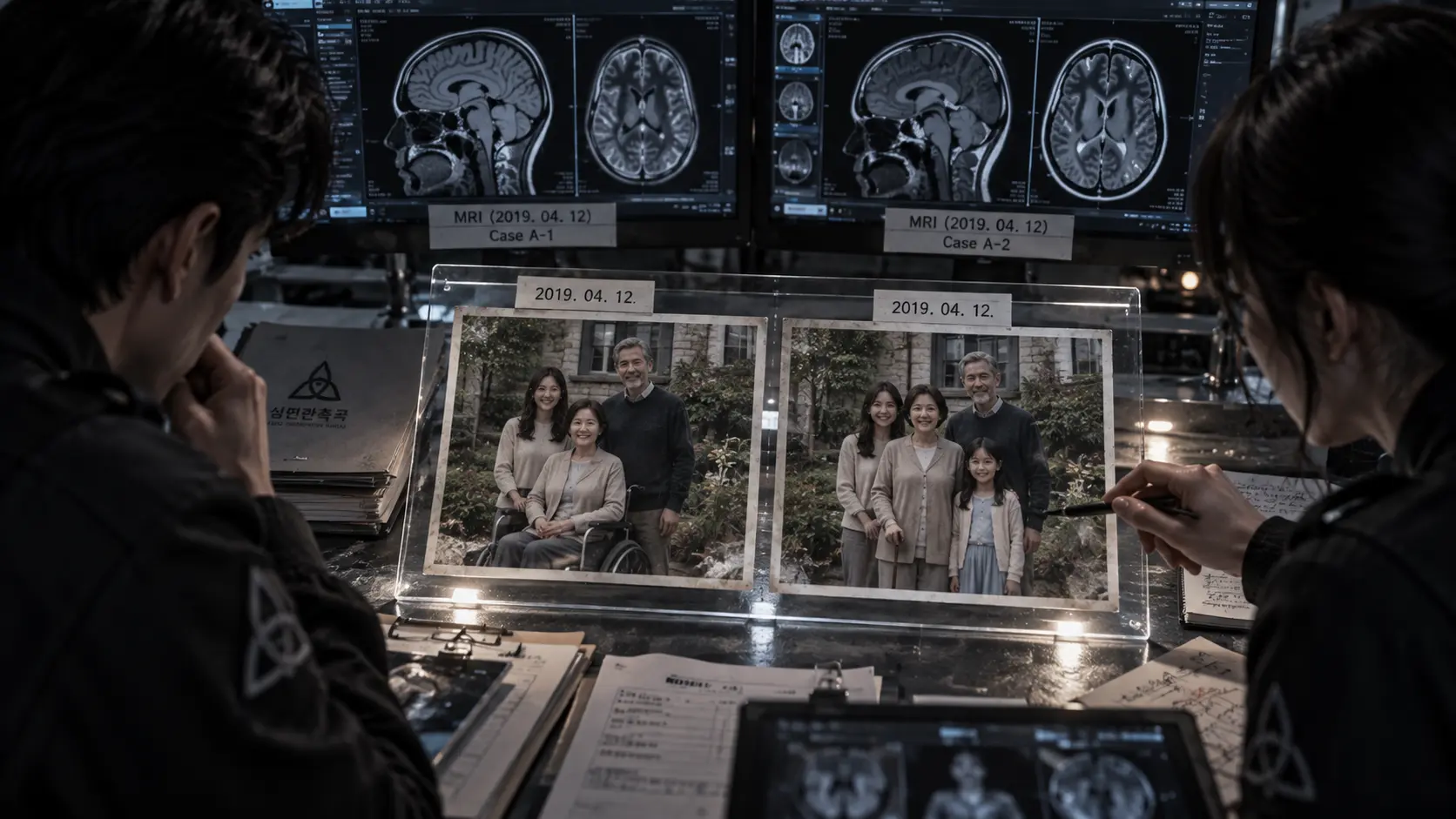
But the MRI performed that day showed—
a significantly less severe injury than earlier imaging.
Equipment failure and patient-record mismatch were initially suspected.
Then the older records began changing.
The Records Began to Change
Original MRI data from the immediate aftermath of the accident existed in two places:
a privately stored disc
and the hospital server.
On the first day—
the two no longer matched.
The private disc still showed the original severe spinal injury.
The hospital server showed a milder injury.
Approximately nine hours later—
the private disc changed as well.
The file's modification timestamp—
did not.
Rehabilitation records changed next.
Portions describing years of wheelchair use disappeared.
In their place were records describing long-term walking rehabilitation.
Family photographs changed.
Images that had previously shown B sitting in a wheelchair now showed her using a cane.
People who had viewed the original photographs the previous day initially reported the difference.
Three days later—
four of five witnesses said:
“I think the photo always looked like that.”
Only the Husband Remembered Differently
A continued to remember everything.
The day they bought the wheelchair.
The day they renovated the bathroom.
Learning how to help B into the car.
The nights they stayed awake together because of pain.
And—
the entire three years following the accident.
B's memories began to blur.
She remembered having used a wheelchair—
but became increasingly uncertain about how long.
On the fourth day, she asked:
“Wasn't it only a few months?”
A could not answer.
The actual period had been—
three years and two months.
Was His Wife Actually Healed?
Medically—
yes.
By Day 12, B could walk independently.
Strength and balance continued improving rapidly.
The problem was the word recovery.
As the records kept changing, B increasingly appeared to have never suffered such a severe injury in the first place.
The accident report changed the angle of impact.
Emergency surgical records described a different injury pattern.
One paramedic stated during the first interview that B had shown no lower-body response after the crash.
Asked again one week later—
he changed his account.
“I think there was some movement.”
At that point, the Bureau began questioning whether ABY-023 was healing B at all.
It may instead have been altering reality—
until B's ability to walk no longer contradicted her history.
How Much Reality Will a Wish Change?
Beginning around Day 15, the rate of change slowed.
B continued walking.
Record alterations stopped.
But the former reality did not vanish completely.
Several analog records isolated early in the incident still preserve evidence of B's original severe injury.
A's memory also remained.
This suggests ABY-023 may not erase the entire past.
It may only alter—
as much of reality as necessary to sustain the current result.
What determines “necessary” is unknown.
A asked for one thing:
his wife to walk.
He did not ask for medical files to change.
He did not ask for family memories to change.
He did not ask for the accident to become less severe.
And yet—
all of those changes became part of the fulfilled wish.
The Second Wish
During the early phase of the incident, A asked the Bureau to return the Monkey's Paw.
He said:
“I can just wish her memories back.”
Han Seo-jin asked:
“Which memories?”
A hesitated.
“The original ones.”
“Which ones are original?”
“The memories after the accident.”
Han continued.
“And the altered medical records?”
“Put those back too.”
“What about your wife's legs?”
A stopped.
Han said:
“If you ask for everything to return to normal, do we know what this object will decide ‘normal’ means?”
A did not request the artifact again.
Second wish:
Unused.
Both A and B remain alive.
B continues to walk.
Can a Wish Be Canceled?
Unknown.
Historical material includes cases in which users attempted to undo a first result with a second wish.
The difficulty begins with the word undo.
“Cancel my first wish.”
“Put everything back the way it was.”
“Make it so that never happened.”
These statements sound similar.
They are not the same.
The Bureau does not know whether ABY-023 reverses an earlier causal alteration—
or simply creates another result that reality must now satisfy.
Current protocol is therefore explicit:
Do not use another wish to repair a previous wish.
Covering one unknown contract with another unknown contract—
is not a response procedure.
Why Three Wishes?
Unknown.
The number three appears repeatedly in associated records.
Most accounts describe one user receiving three successful activations.
Some cases indicate that the same person could no longer trigger the object after the third.
Why three—
and what qualifies someone as a new user—
remain unanswered.
Inheritance.
Sale.
Theft.
Gift.
Forced transfer.
The Bureau has no intention of experimentally testing every possibility.
Ownership-transfer experiments involving the recovered ABY-023 have been suspended.
One proposal argued that the question could be settled easily:
give the object to someone else and ask them to make a wish.
The Ethics Committee response was equally simple.
“We will not find out.”
Is a More Precise Wish Safer?
Unconfirmed.
One proposal suggested constructing wishes like legal contracts—
adding dozens of conditions designed to prevent unintended consequences.
The problem is that the Bureau does not know whether ABY-023 responds to grammar—
semantic meaning—
or the user's actual underlying desire.
A more detailed wish might require an even wider alteration of reality.
Consider:
“I want to receive money without anyone being injured, without causing harm to anyone, and without changing any of my existing relationships.”
It sounds safer.
But if reality must satisfy every condition—
how much of the world would need to change?
Seo Yu-jin ended the discussion with two sentences:
“Our goal is not to write a perfect wish.”
“Our goal is not to make one.”
Avoidance and Contact Protocol
- If an object resembling a dried primate paw is recovered, do not touch it with bare skin.
- Do not verbalize a wish simply to test whether the object is active.
- Avoid asking someone holding the object open-ended questions such as “What do you want?”
- If activation has already occurred, record the user's first account immediately.
- Document separately what was said, what the user actually intended, and the surrounding circumstances.
- Do not immediately attribute every later coincidence to ABY-023.
- At the same time, do not immediately dismiss it as coincidence.
- Duplicate digital records immediately.
- Whenever possible, preserve analog or fully offline copies isolated from networks.
- Record witness memories before repeated interviews can influence them.
- Never use an additional wish as an emergency response measure.
Response Certainty | Conditional
Avoiding activation is comparatively straightforward.
Do not touch it.
Do not make a wish.
Do not intentionally test it.
Inactive containment has therefore remained relatively stable.
The real uncertainty begins after a wish has already been accepted.
The Bureau has no established procedure for determining:
when the result becomes fixed,
how far reality will change,
which memories and records will remain,
or when the causal alteration has actually ended.
That is why Response Certainty remains:
Conditional.
ABY-023 has not become safe.
It means only that the most reliable method discovered so far is—
not using it.
Current Management Status | Conditional Containment
The recovered ABY-023 is stored inside a sound-isolated containment case.
Direct contact is prohibited.
All movement is performed remotely.
Free-form natural conversation inside the containment room is restricted.
Operational instructions use approved fixed phrases and codes.
This is not because particular words such as—
“I want,”
“I wish,”
or—
“I hope”
are uniquely dangerous.
ABY-023 may react to meaning and intent, not vocabulary.
For that reason, the safest procedure is simpler:
do not talk about what you want while inside the containment room.
Lumi's Field Notes
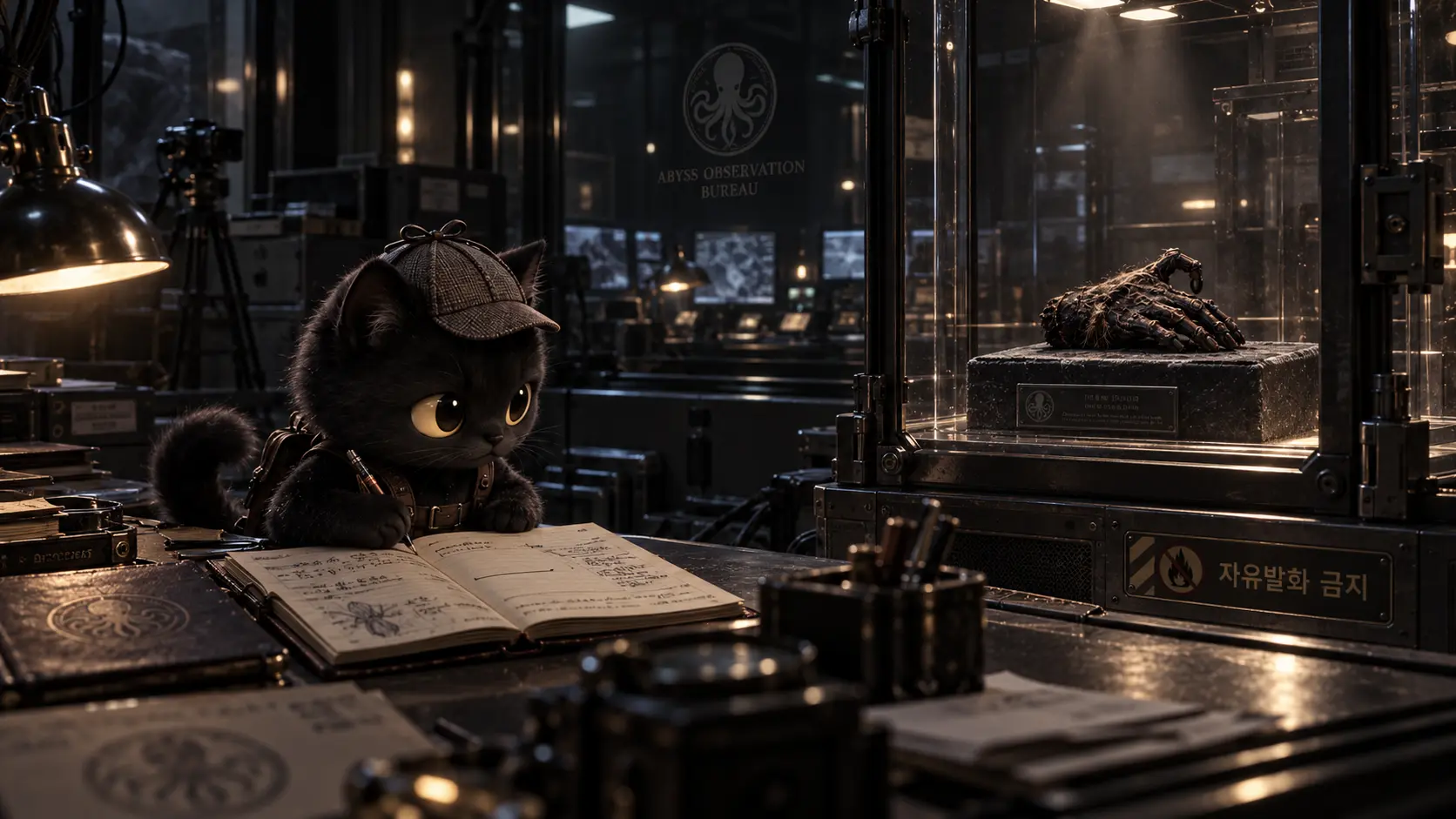
After ABY-023 was contained, Lumi spent a long time staring at it through the glass.
Lumi did not enter the room.
Lee Do-yoon asked:
“Have you ever made a wish?”
“Yeah.”
“With that?”
“No.”
“What did you wish for?”
Lumi thought.
“Don't remember.”
“Did it come true?”
“Probably.”
Lee pointed toward the Monkey's Paw.
“Why does that thing grant wishes by making people miserable?”
Lumi looked at him.
“Are you sure that's what it's doing?”
“Look at what happens.”
Lumi was quiet for a moment.
Then asked:
“He wished for his wife to walk, right?”
“Yeah.”
“Does she walk?”
“Yeah.”
“Then it granted the wish.”
Lee stared at Lumi.
“It changed her memories and the records too.”
Lumi tilted their head.
“Did he tell it not to?”
“Who thinks to say every little thing?”
“Exactly.”
Seo Yu-jin asked:
“So you're saying the object isn't malicious?”
Lumi watched the paw for a long time.
“Don't know that either.”
“Then what?”
“You keep telling it the result.”
No one answered.
Lumi continued:
“No one decides what happens in the middle.”
The following is reproduced from Lumi's original submission.
Wishes are strange.
Humans say the result first.
I want money.
I want to be healthy.
I want them to come back.
I want it to disappear.
But—
how?
Who?
What has to change?
You don't say those parts very often.
I don't know if the Monkey's Paw is evil.
Maybe it really does
exactly what you asked.Is that scarier?
...
And calling it a “price”
is a little strange too.You don't know
if it's actually taking payment.If you wished for money
and someone died
and the money came to you as insurance—
did the paw kill them?
Was someone already going to die
and the money just came to you?Or did reality connect everything
because it needed that result?I don't know.
So don't hold it and say—
“Make sure nothing happens.”
Because if reality has to make
a world where nothing happens—you don't know what has to disappear.
— Lumi
Records Left in the Real World
From this section onward, the discussion concerns the real literary work and its publication history rather than the fictional setting of Codex of the Abyss.
The Monkey's Paw Is Not an Ancient Folklore Artifact
“The Monkey's Paw” is a horror short story by British writer W. W. Jacobs.
It was published in 1902 and was later included in Jacobs's collection The Lady of the Barge and Other Stories.
The story is therefore a work of literary fiction—
not documentation of an actual ancient Indian magical artifact.
India and a fakir do appear in the story's fictional history of the paw.
That is part of Jacobs's narrative.
It should not be presented as a verified historical belief, religious artifact, or traditional Indian object.
The distinction matters.
The Monkey's Paw in the Original Story
In Jacobs's story, the retired Sergeant-Major Morris shows the White family a dried monkey's paw.
He explains that an old fakir placed a spell upon it to demonstrate that human lives are ruled by fate—
and that those who interfere with fate do so to their sorrow.
According to Morris, three people can each receive three wishes.
Morris has already used his own.
He also says that the previous user's third wish was for death.
Morris throws the paw into the fire.
Mr. White retrieves it.
All of this belongs to the fictional story.
It should not be treated as historical evidence about Indian religion or folklore.
The First Wish | Two Hundred Pounds
The White family's first wish is relatively modest.
Mr. White wishes for £200, an amount connected to the financial burden on the family's home.
The following day—
their son Herbert dies in an industrial machinery accident.
The company denies legal liability but offers the family a payment.
The amount is—
£200.
The money does not fall from the sky.
The wish is fulfilled through a sequence of events that could, individually, occur within ordinary reality.
That ambiguity is important to Jacobs's story.
Characters can still ask whether what happened was supernatural—
or merely coincidence.
This structure strongly influenced the Codex concept of Result-First.
However—
Jacobs does not describe historical documents rewriting themselves or reality retroactively changing its causal record.
Those mechanisms are original to ABY-023.
The Second Wish and the Knocking at the Door
After Herbert's death, Mrs. White urges her husband to use the second wish to bring their son back.
Mr. White knows how badly Herbert's body was damaged and is terrified of what might return.
He eventually makes the wish.
At first—
nothing happens.
Later that night—
knocking begins at the front door.
Mrs. White becomes convinced Herbert has returned and desperately tries to open it.
Mr. White fears whatever may be waiting outside.
Jacobs never directly shows the thing at the door.
The reader never sees it.
That refusal to reveal the answer is one of the story's most effective sources of horror.
What Was the Third Wish?
Just before Mrs. White opens the door, Mr. White finds the paw and uses his final wish.
The knocking stops.
When the door is opened—
the road outside is empty.
One detail is important:
Jacobs never explicitly states the exact words or content of Mr. White's third wish.
Its meaning is inferred from the situation.
It should therefore not be presented as though the story directly gives a specific final wish.
Is the Original Story Really About an Evil Object Twisting Wishes?
Modern popular culture often uses “monkey's paw” as shorthand for a wish that technically comes true but produces horrific unintended consequences.
That idea is understandable.
But Jacobs's story never clearly states that the paw hates humans—
or consciously chooses the cruelest possible interpretation of their wishes.
The fictional explanation instead emphasizes:
human interference with fate and the suffering that follows.
The supernatural events are also presented through circumstances that can appear unnervingly natural.
Codex of the Abyss keeps that ambiguity but changes the interpretation.
ABY-023 is not confirmed to punish wish-makers.
Instead—
it may first establish the desired result and then force reality's causal structure to become compatible with it.
The Original Story and the Codex
Elements found in W. W. Jacobs's original story include:
- a dried monkey's paw
- three users receiving three wishes each
- the warning that interfering with fate brings sorrow
- a previous owner who regrets using the object
- the wish for £200
- Herbert's fatal workplace accident
- compensation in exactly the wished-for amount
- the second wish asking for the dead son to return
- knocking at the front door
- a third wish whose exact content is never directly revealed
- deliberate ambiguity between supernatural intervention and coincidence
The following elements are original expansions created for Codex of the Abyss:
- the designation ABY-023
- classification as a Linguistic-Contract · Causality-Altering Forbidden Object
- a finger curling inward after each activation
- the hypothesis that the artifact recognizes intent
- the Domain The Wish Already Fulfilled
- the provisional Result-First trait
- the idea that the result becomes fixed before reality produces an adequate cause
- records and memories rewriting themselves to match the new causal structure
- the wish-maker retaining the previous reality longer than others
- Incident ABY-023-A
- Bureau policy forbidding additional wishes as a method of correction
- modern sound-isolated and contact-free containment
- Lumi's investigation records
Most importantly—
the interpretation that:
the Monkey's Paw may not maliciously twist a wish at all, but may instead leave the unspoken process for reality itself to determine
is not an official rule of Jacobs's story.
It is an original Codex hypothesis inspired by the story's unsettlingly natural methods of wish fulfillment.
Abyss Record Summary
ABY-023 | The Monkey’s Paw
Chapter: Chapter V: Forbidden
Classification: Linguistic-Contract · Causality-Altering Forbidden Object
Threat Level: Deep
Management Status: Conditional Containment
Response Certainty: Conditional
Volition: Unconfirmed
ABY-023 is a forbidden object suspected of altering causal reality when a user makes physical contact while clearly expressing a genuinely desired result.
Domain | The Wish Already Fulfilled
Primary Domain Type: Overlapping Domain · Expanding Domain
Secondary Traits: Causal Distortion · Linguistic Binding · Contract Priority
Unique Trait: Result-First — provisional
Current Bureau hypothesis:
ABY-023 fixes the desired result first.
Then—
reality begins creating the causes required to reach it.
ABY-023-A | His Wife Was Walking
A man whose wife had sustained severe spinal cord injury made one wish:
“I wish my wife could walk again.”
The following day—
her physical function began returning.
Medical records changed.
Family photographs changed.
Witness memories changed.
The phenomenon stabilized approximately fifteen days later.
Subject B:
Walking
Fatalities:
0
Second wish:
Unused
Current Most Important Finding
A fulfilled wish does not prove—
that ABY-023 helped the user.
Misfortune does not prove—
that ABY-023 punished them.
Only one fact is currently secure:
the stated result may come true.
And—
the user does not control what reality must change to make that result possible.
Core Directives
Do not touch ABY-023 directly.
Do not activate it for testing.
Do not use a second wish because you dislike the first result.
Do not assume more precise wording makes a wish safe.
The most reliable response remains—
do not use it.
Lumi's Key Record
“You keep telling it the result.”
“No one decides what happens in the middle.”
Regarding the supposed “price”:
“You don't know if it's actually taking payment.”
And finally:
“Don't say, ‘Make sure nothing happens.’”
Because—
“If reality has to make a world where nothing happens, you don't know what has to disappear.”
The Bureau currently makes no stronger conclusion.
END OF RECORD.


