If the Fifth Flame Won't Light, Count Everyone in the House Again
Codex of the Abyss — Chapter V: Forbidden | Record 017
Record FieldDetails
| Record No. | ABY-017 |
| Designation | Hand of Glory |
| Chapter | Chapter V: Forbidden |
| Classification | Artificial Ritual Medium · Intrusion-Facilitating Forbidden Object |
| Threat Level | Deep |
| Origin | Associated with European ritual and thief folklore / Original maker unknown |
| Known Population | Multiple confirmed / Total number unknown |
| Primary Traits | Dried human-hand form · anomalous ignition · voluntary motor suppression · boundary-based Domain formation · occupant-identification phenomenon |
| Management Status | Conditional Containment |
| Response Certainty | Conditional |
| Activation Conditions | Ritual ignition + crossing the boundary of an occupied space |
| Special Directives | Do not assemble components · Do not ignite · No open-site activation experiments · No solo recovery |
| Recorder | Lumi |
Contact Warning
Finding ABY-017 is not, by itself, an immediate emergency.
If the flames are out, the attached components have been separated, and no one carries the object across a threshold, most recovered specimens have remained inactive.
The danger begins after ignition.
If you encounter an ABY-017 that is already burning—
do not attempt to wake the people inside.
More precisely—
do not assume they are asleep.
An exposed person may have their eyes closed.
They may not answer you.
Their breathing may remain normal.
Their pulse may still be present.
But none of that means they cannot hear your footsteps.
Several survivors have remembered everything that happened while ABY-017 was active.
They were not asleep.
They simply could not move.
ABY-017 — Hand of Glory
Recovered ABY-017 specimens do not all share the same appearance.
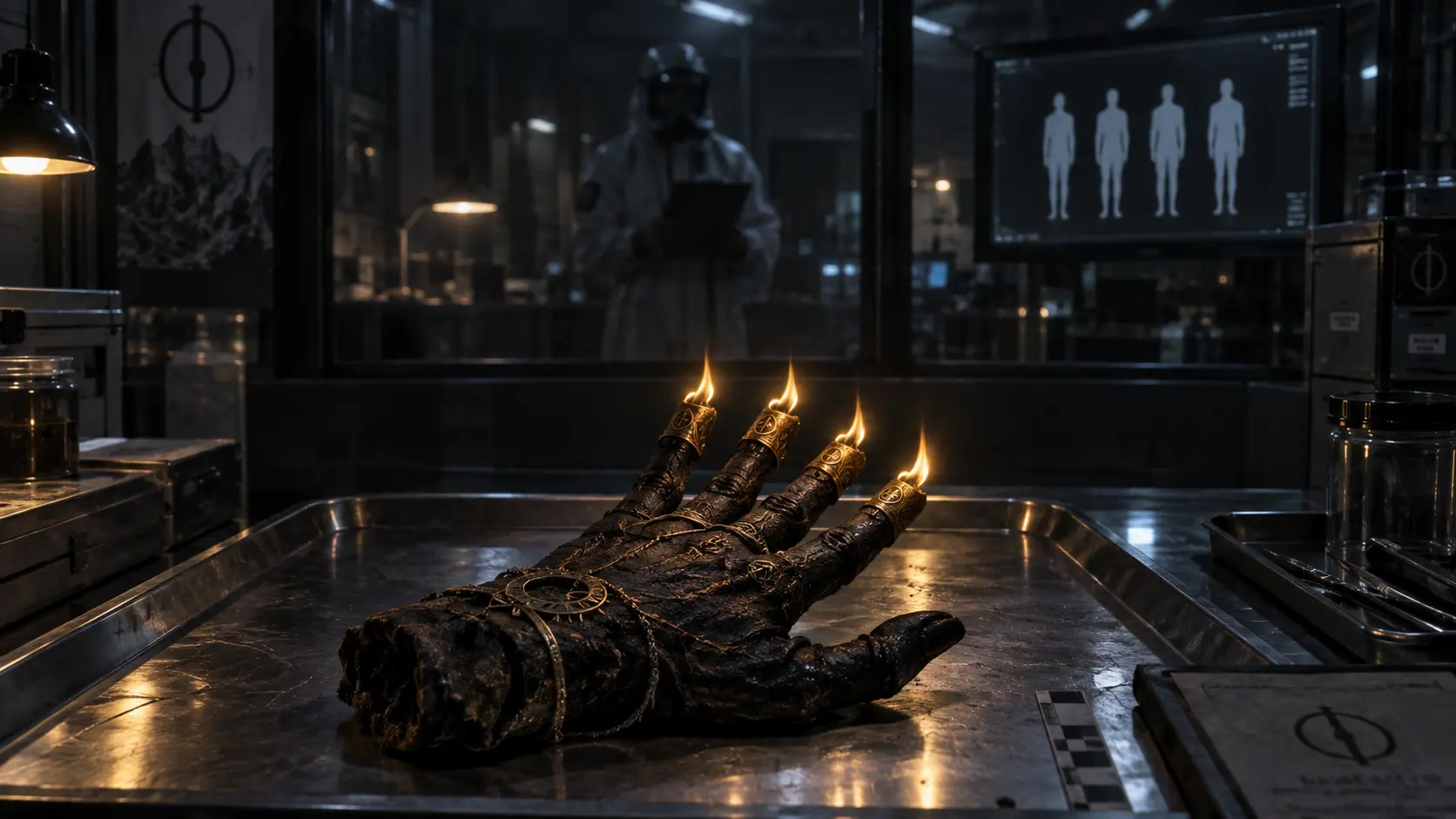
Some resemble a dried human hand with the fingers curled inward and a structure in the palm capable of holding a candle or other ignition material.
Others have fully extended fingers, each bearing traces of burning at the tip.
Several specimens are missing one or more fingers.
Both right and left hands have been recovered.
Construction methods also appear to vary.
The Bureau initially classified the items as unrelated folk ritual objects.
That changed after specimens recovered from three different regions produced the same two phenomena when activated:
voluntary motor suppression affecting people inside an occupied space
and—
a finger that refused to ignite.
The objects are now managed under one ABY group.
However, the Bureau has not concluded that every ABY-017 was made by the same process or operates according to the same mechanism.
Human beings giving several things the same name—
does not prove they are the same thing.
Does It Put People to Sleep?
Early Bureau records assumed that it did.
European folklore repeatedly describes thieves using a Hand of Glory to enter a house while everyone inside falls into an unnatural sleep or becomes impossible to awaken.
The original Bureau classification was therefore:
Sleep-Inducing Forbidden Object
That classification was discarded after Incident ABY-017-A.
Three of the four exposed residents were conscious during the event.
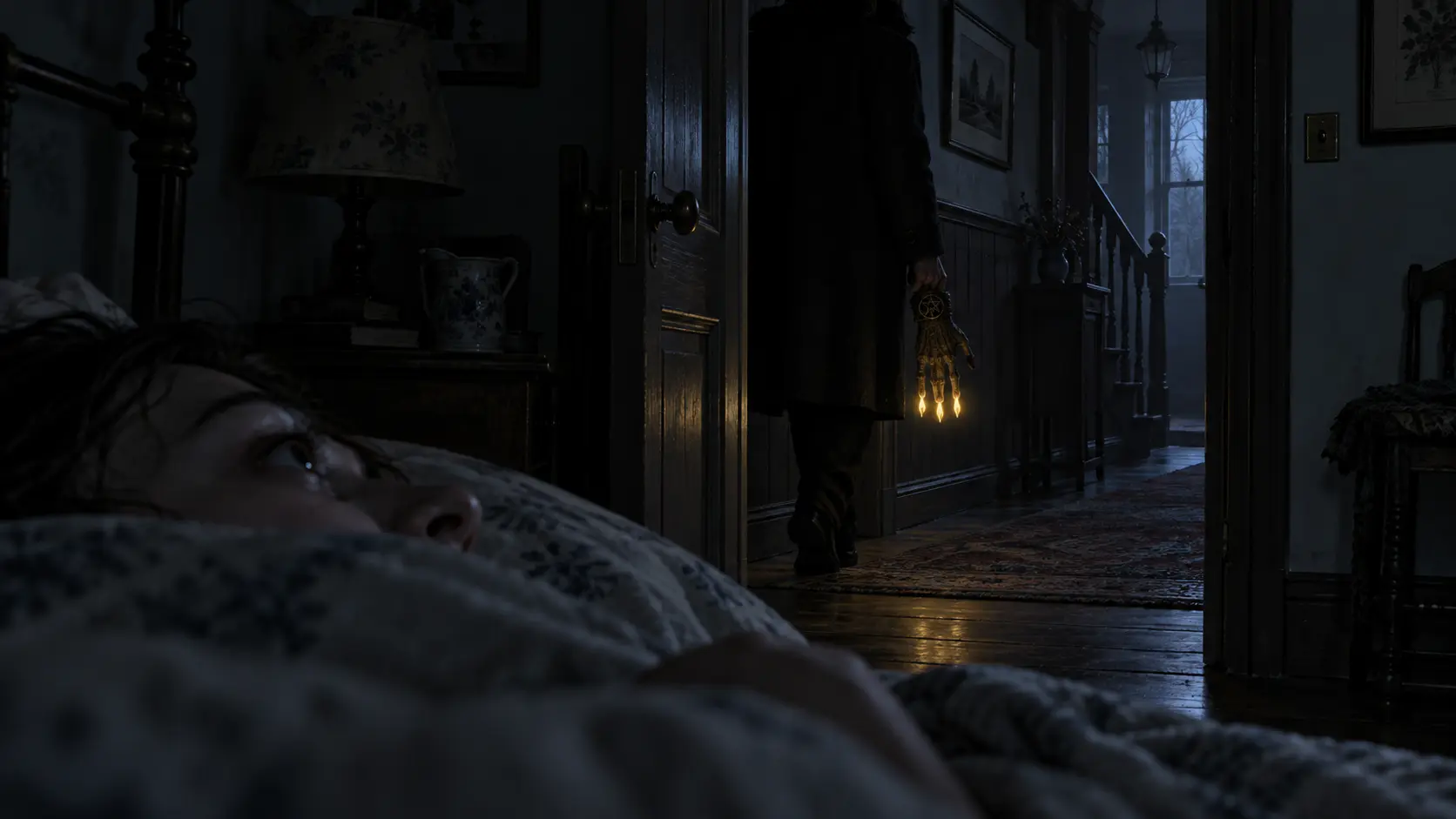
They heard footsteps coming up the stairs.
They heard drawers opening.
They heard members of the family trying to call out.
One victim remembered the intruder opening the bedroom door.
But none of them could open their eyes.
They could not speak.
They could not move.
One survivor later told investigators:
“Honestly, I wish I'd been asleep.”
“I could hear his shoes dragging on the floor when he walked past me.”
“I kept trying to ask for help. My mouth wouldn't move.”
The Bureau now records ABY-017's primary effect not as sleep—
but as suppression of voluntary motor function.
Not every exposed person remains conscious.
Some remember nothing.
Some recall the event as though it were a dream.
One individual described memories extending approximately forty-three minutes beyond the documented activation period.
The exact mechanism remains—
unconfirmed.
Why Did It Become a Thief's Tool?
No recovered ABY-017 has been confirmed to kill a human directly.
It does not break doors.
It does not steal valuables on its own.
It does not order the user to commit a crime.
And yet ABY-017 has repeatedly appeared in connection with burglary for a very simple reason.
It removes the people who could resist.
A door opens.
Someone lies inside.
They do not sit up.
They do not call for help.
They do not fight back.
And the user walks through the house.
For this reason, the Records Analysis Division treats ABY-017 less as a weapon and more as an environmental manipulation object that facilitates intrusion.
There is, however, a problem.
ABY-017 appears to distinguish its user from everyone else.
In many incidents, the person carrying the object remains unaffected while inside the Domain.
There are also cases in which an accomplice continued to move normally.
In other incidents, someone who entered alongside the user suddenly lost all voluntary movement.
The criteria by which ABY-017 distinguishes—
intruder
from—
occupant
remain unknown.
Domain | The Sleepless House
ABY-017 does not possess a permanent territory.
Instead, it appears to generate a temporary Domain when an activated specimen crosses into a space already occupied or claimed by another person.
Bureau provisional designation:
The Sleepless House
Domain FieldDetails
| Domain Name | The Sleepless House |
| Primary Domain Type | Overlapping Domain |
| Secondary Traits | Law Distortion |
| Unique Trait | Occupancy-Boundary Effect — provisional classification |
| Estimated Range | Area recognized as one occupied space at the moment of activation |
| Entry Condition | Crossing a spatial boundary while carrying an activated ABY-017 |
| Entry Signs | Change in illumination · flames cease flickering · outside noise decreases · occupants lose voluntary movement |
| Threat Level | Deep |
| Exit Procedure | Remove activation source and exit the Domain / Deactivation conditions vary by specimen |
| Bureau Response | Site lockdown · external observation · prioritize non-exposure methods · no direct entry while specimen remains active |
The strangest part is that range does not appear to be determined by physical distance.
In a small studio apartment, one room was affected.
In a two-story house, the entire building was affected.
Yet in another case, separate rental units inside the same structure remained outside the effect.
The Bureau initially assumed doors and walls defined the Domain.
That assumption was wrong.
The effect has persisted through open windows.
Some spaces remain separate even when no physical door exists between them.
In other cases, a locked door failed to interrupt the Domain at all.
The current leading hypothesis is that ABY-017 prioritizes not architectural boundaries—
but the boundary of a place someone recognizes as their own space.
A house.
A room.
A lodging.
A shop.
A warehouse.
And in at least one case—
a vehicle.
This creates a more difficult question.
Who must consider the space theirs?
The legal owner?
The resident?
The person currently sleeping there?
Someone who has occupied it for a long time?
Or does the Domain form because the ABY-017 user believes—
I am entering someone else's space?
The Bureau does not know.
For that reason, the Occupancy-Boundary Effect remains a provisional unique trait rather than an official Domain classification.
So far—
it has only been confirmed in ABY-017.
Do the Flames Count People?
The phenomenon does not occur in every ABY-017 specimen.
However, several types in which the fingers themselves are ignited display the same anomaly:
one finger refuses to burn.
The Bureau initially investigated humidity, physical damage, fuel deficiency, and differences in tissue condition.
Then researchers found older folklore offering another explanation.
If one finger will not light, someone in the house is still awake.
Before ABY-017-A, this was treated as a decorative element of folklore.
It is no longer dismissed so easily.
The problem is the word—
awake.
ABY-017 victims may remain conscious even while completely unable to move.
So what exactly is the flame counting?
People who are awake?
People who can still move?
People who resisted the effect?
People the user does not know about?
Or—
something that is not human at all?
That question remains open.
Incident Record ABY-017-A | The Fifth Flame Would Not Light
2022 / Northern England / North Yorkshire / Observation Zone UK-17
The original call was not considered anomalous.
It was a residential burglary.
Time of report:
02:41
Two-story detached house.
Four residents.
No damage to the front door.
No broken windows.
Several valuables missing.
When police arrived, all four residents were alive.
And all four were lying in beds or on a sofa.
At first, investigators suspected chemical sedation.
Blood analysis and respiratory examination found no evidence supporting the use of a conventional sedative or anesthetic.
The stranger detail emerged when the residents began moving again.
Three of them said exactly the same thing.
“We weren't asleep.”
02:17
A masked male was recorded on a first-floor living-room camera.
He carried an object wrapped in cloth.
The man remained at the front door for approximately forty seconds.
Footage shows him handling the lock, but the exact method by which the door opened cannot be identified.
Once the door opened, he removed the cloth.
Inside was an object resembling a dried human hand.
Four faint flames burned from the fingertips.
The thumb—
was dark.
The intruder stared at it for approximately six seconds.
He attempted to light it twice.
Both attempts failed.
There was no third attempt.
He entered the house anyway.
02:18
The living-room camera recorded Resident B speaking.
“Who's there?”
Immediately afterward, B stopped moving.
On video, it looked like sleep.
B later stated:
“That's when I could hear everything.”
“Only my body stopped working.”
02:21
The intruder opened the kitchen drawers.
He went upstairs.
First bedroom.
Second bedroom.
Hallway storage.
Total movement time inside the house:
approximately fourteen minutes.
One resident claimed that the intruder stopped outside their bedroom for eleven seconds.
There was no camera in that part of the house.
The resident said:
“I could see light beneath the door.”
“It didn't look like candlelight.”
“There were five of them, but one was dark.”
The investigator asked again:
“Five?”
The resident answered:
“Yes.”
“They looked like fingers.”
But There Were Only Four People in the House
Residential records.
Phone records.
Recent lodging records.
Nearby CCTV.
Family statements.
Everything was checked.
Four people lived in the house that night.
No visitors.
No pets.
One intruder.
Four people believed to have been affected by ABY-017.
And yet—
four fingers burned.
One never lit.
The initial report attributed the failed ignition to incomplete combustion.
Seo Yu-jin objected after examining the recovered object.
“There's an old account describing the same thing.”
Han Seo-jin asked:
“A finger that won't light?”
“Yes.”
“What is it supposed to mean?”
Seo turned through several pages of notes before answering.
“Traditionally, it means someone inside the house is still awake.”
Yoon Tae-kyung said:
“There were four victims.”
“I know.”
“And you said all four may have been conscious.”
“That is why it's strange.”
The meeting stopped there.
No one could explain—
what ABY-017 was counting.
02:36
The intruder returned downstairs.
At that moment, the flames on ABY-017 shook violently.
The living-room camera froze for approximately 2.8 seconds.
When the feed returned, the intruder was staring toward the entrance.
He said clearly:
“Who's there?”
No answer was recorded.
But he was not looking at the front door.
He was looking—
toward the wall beneath the staircase.
For approximately seven seconds.
Then he dropped the bag.
Opened the front door.
Ran.
He abandoned ABY-017 on the floor.
Immediately after the intruder fled, the four residents began regaining motor function one by one.
First recovery:
nineteen seconds.
Last recovery:
one minute and forty-six seconds.
The emergency call was made shortly afterward.
Why Did the Intruder Run?
He was arrested approximately three hours later.
Stolen property was found in his possession.
He admitted to the burglary.
He also admitted to using ABY-017.
But his explanation of where the hand came from changed repeatedly.
First:
he bought it online.
Second:
he inherited it from a dead relative.
Third:
“It was already in the house.”
The statements were mutually inconsistent.
Drug influence, memory contamination, and deliberate deception were all considered.
No conclusion was reached.
Investigators returned to one question repeatedly.
“Why did you run?”
His first answer:
“There was someone else in the house.”
“Where?”
“Inside the wall.”
Second interview:
“It wasn't a person.”
Third interview:
“I didn't see anything.”
Beginning with the fourth interview—
he claimed to remember nothing about that part of the incident.
The Space Behind the Wall
The initial police search found nothing unusual.
After the Bureau assumed control of the scene, Park Do-hyeon compared the building plans with the measured interior dimensions.
They did not match.
The discrepancy was approximately—
1.2 meters.
The missing space appeared to lie between the area beneath the staircase and the first-floor bedroom.
The wall was opened.
A narrow cavity was found.
Approximately seventy-four centimeters wide.
Approximately 2.3 meters long.
Too narrow to stand comfortably, but wide enough for a person to turn sideways and enter.
There was no door.
No ventilation.
No electrical wiring.
No evidence of recent construction.
No person was found inside.
No remains.
No object.
The only feature was on the inner wall.
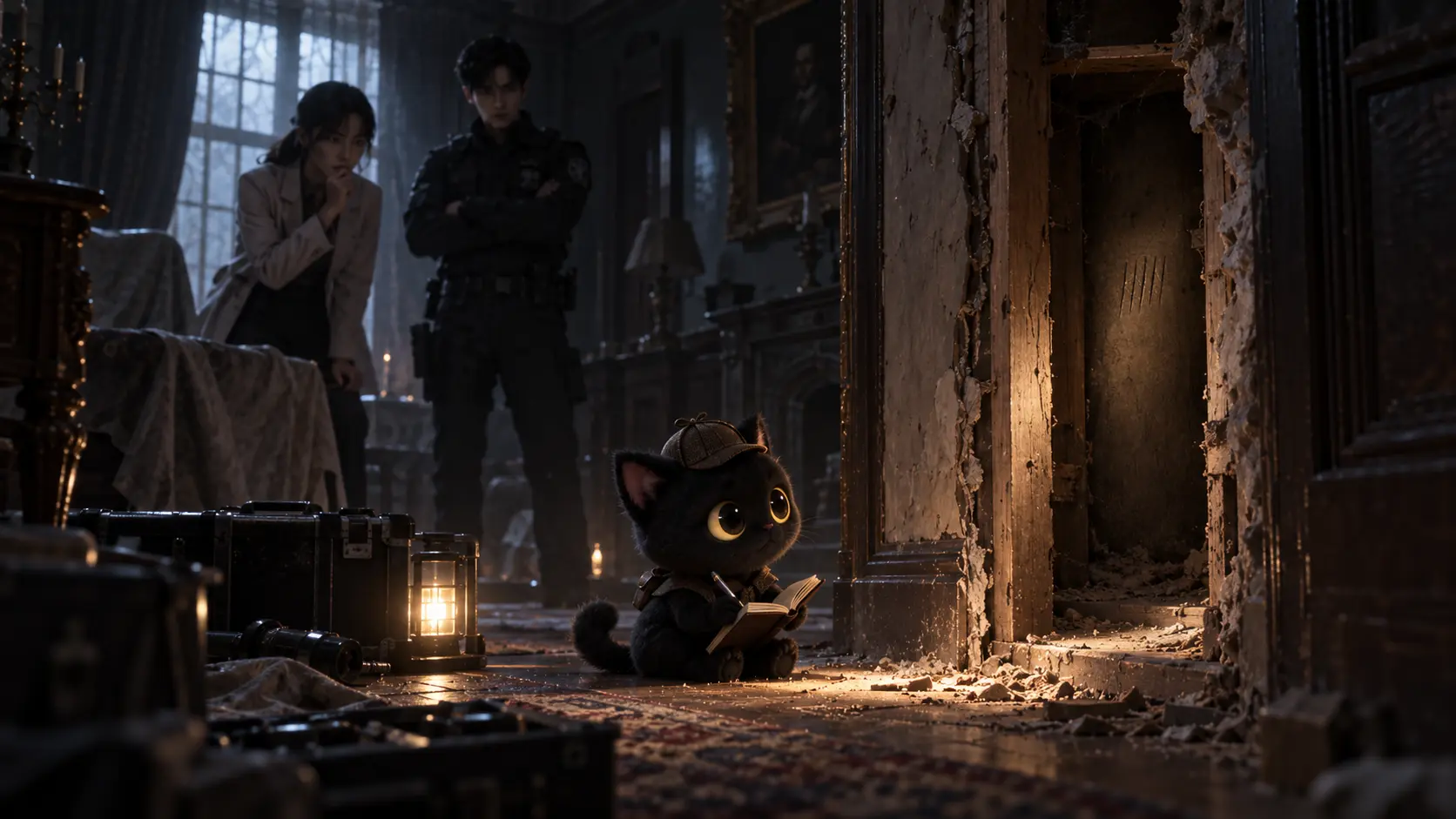
Five scratch marks.
Whether they had been made by human fingers could not be determined.
Yoon Tae-kyung immediately ordered an expanded search.
Result:
none.
Thermal imaging:
none.
Biological signal:
none.
Anomalous response:
none.
Han Seo-jin wrote the following sentence in the final site report:
“No causal relationship has been established between the fifth failed ignition of ABY-017 and the cavity inside the wall.”
Park Do-hyeon added another sentence directly underneath it:
“Therefore, no conclusion has been made that they are unrelated.”
What Did the Four Victims Remember?
The Bureau interviewed all four residents separately.
They were given no opportunity to compare accounts.
Three described remarkably similar details.
The intruder's footsteps.
The zipper on his bag.
Drawers opening.
Doors.
Stairs.
And—
a sound from inside the wall.
Resident C:
“I thought it was a rat.”
Resident A:
“It was scratching.”
Resident B:
“It sounded like someone tapping from the inside with their fingernails.”
The fourth resident initially claimed to have heard nothing unusual.
At the end of the interview, however, they added:
“There was one strange thing.”
“What?”
“Right before he ran, someone laughed under the stairs.”
None of the other three residents reported hearing laughter.
The sound does not appear on the recovered recording.
Was the Thing in the Wall Part of ABY-017?
We do not know.
That distinction matters.
The Bureau has not registered the wall phenomenon as an ability of ABY-017.
It has not concluded that the fifth flame detected something inside the cavity.
Several explanations remain possible.
The hidden space may have had nothing to do with ABY-017.
The intruder may have misperceived something because of fear.
The victims' memories may have changed after the event.
ABY-017 may have been measuring something other than the number of people present.
Or—
the house may already have contained something unrelated to the Hand of Glory.
The official conclusion remains:
Unconfirmed.
The residence remained under observation for eleven months after ABY-017-A.
No further anomalous events occurred.
The cavity did not change.
The five scratch marks did not increase.
No separate ABY designation was issued.
Does ABY-017 Move on Its Own?
No.
There are currently no confirmed cases of ABY-017 moving under its own power.
No confirmed speech.
No recorded commands to the user.
No evidence that it selects its own user.
Based on current evidence, ABY-017 appears closer to a tool than an intelligent entity.
But calling it completely passive is also difficult.
It distinguishes occupied spaces.
It appears to select who is affected.
Some of its fingers refuse ignition.
None of those behaviors can be explained as ordinary combustion or mechanics.
In ABY-017-A, the artifact affected four residents while leaving the intruder free to move.
Does the object recognize its user?
Does simply holding the Hand grant exemption?
Does another ritual protect the carrier?
Unknown.
Seo Yu-jin summarized the problem this way:
“There isn't enough evidence to call it self-aware.”
“But there is also too much happening to say it makes no distinctions at all.”
Current record:
Autonomy: Unconfirmed
How Do You Extinguish the Flames?
Older folklore frequently claims that the flames of the Hand of Glory cannot be extinguished by ordinary means.
The Bureau has observed similar behavior.
At the ABY-017-A scene, the flames continued for approximately four minutes after the artifact was dropped.
The first responding officers used water.
The flames did not immediately go out.
The Bureau does not treat this single event as proof of an absolute rule that water cannot extinguish ABY-017.
Other recovered specimens have stopped burning after ordinary oxygen deprivation.
Another case ended immediately after a dairy-based liquid was applied.
The sample size is small and differences between specimens are substantial.
For this reason, the Bureau does not teach specific extinguishing methods drawn from folklore as Established response procedures.
The current protocol is simpler.
Do not ignite it.
If it is already burning—
do not send additional personnel into the Domain it has created.
Activation Conditions
Igniting ABY-017 does not automatically create a Domain.
Two accidental minor ignition events inside containment facilities produced no motor-suppression effect in nearby personnel.
During ABY-017-A, however, the phenomenon began immediately after the user crossed the front door.
The Bureau currently suspects that at least two conditions are required.
First: an activated flame.
Second: crossing the boundary of a space occupied by someone else.
Whether those are the only conditions remains unknown.
Intent may also matter.
The intention to steal.
To enter secretly.
To avoid being discovered.
Historical records frequently associate the Hand of Glory with precisely those situations.
For that reason, controlled reenactment experiments were discontinued.
Yoon Tae-kyung summarized the objection:
“You want to confirm the conditions by staging an actual break-in?”
The proposal was rejected.
Current suspected activation pattern:
Behavior-Based · Location-Based · Ritual-Based compound conditions.
Avoidance Protocol
- Do not ignite ABY-017 or any unidentified ritual object shaped like a human hand.
- Separate candles, wicks, fuel, and ritual components attached to the fingers or palm and store them independently.
- Do not assume a specimen is inactive merely because there are no visible burn marks.
- If flames are already present at a recovery site, do not enter the affected building.
- If an activated ABY-017 carrier has crossed a threshold, prioritize external observation rather than approaching the occupants directly.
- Do not assume an unresponsive victim is asleep or dead.
Contact Protocol
- Do not directly handle an activated ABY-017.
- Do not enter an active Domain solely to forcibly remove the artifact from its user.
- Do not attempt to extinguish the flames with bare hands, water, or improvised liquids.
- Do not determine consciousness based only on outward response.
- After the Domain ends, do not force exposed individuals to repeat their memories immediately.
- If one finger refuses ignition, do not conduct a solo search for a hidden occupant.
The final directive was added after Incident ABY-017-A.
Response Certainty
Conditional
Inactive ABY-017 specimens can be managed for extended periods through component separation.
There have been no confirmed cases of spontaneous activation inside containment.
The artifact itself is therefore not exceptionally difficult to contain.
The situation changes after activation and Domain formation.
Who will be affected?
How long will the effect last?
Which boundary will the object recognize?
What does the number of burning fingers represent?
Too much remains unknown.
That is why the current Threat Level is—
Deep.
Not because the object is physically powerful.
But because someone who knows how to use it may enter an ordinary house, lodging, or occupied building—
and take away the ability of multiple people to resist at once.
Current Management Status | Conditional Containment
All recovered ABY-017 specimens and associated ritual components are stored separately.
Hand.
Candle.
Wick.
Ritual accessories.
Unidentified fuel.
Each component is kept in a different containment unit.
Authorization is divided so that no single staff member can open all associated containers at the same time.
Ignition devices are prohibited.
Flame testing is prohibited.
Full reassembly is prohibited.
Experiments intended to reconstruct a real occupied residence for activation testing have also been suspended.
Park Do-hyeon wrote one sentence at the top of the containment document:
“If the safest thing to do is not light it, why are we trying to light it?”
The line was adopted without revision.
Lumi's Field Notes
After Incident ABY-017-A, Lumi spent several minutes staring at the recovered artifact.
Lumi did not touch it.
Instead, the small black cat climbed onto the table and brought their face closer to the unlit thumb.
Park Do-hyeon immediately said:
“Don't touch it.”
“I'm not touching it.”
“Don't smell it either.”
“I'm not smelling it.”
“Don't put your face that close.”
Lumi looked at him.
“Already did.”
Park moved the containment line another thirty centimeters backward.
Han Seo-jin asked:
“Does this thing put people to sleep?”
Lumi answered:
“Doesn't look like it.”
“Why?”
“They were awake.”
Seo Yu-jin joined the conversation.
“According to the folklore, if one finger doesn't burn, someone inside the house is still awake.”
Lumi looked at the thumb.
“Yeah.”
“But all four victims were conscious.”
“Yeah.”
“Then what was the flame counting?”
Lumi thought for a moment.
“Are you sure it counts people?”
“I'm asking because I don't know.”
“I don't know either.”
Yoon Tae-kyung placed a photograph of the wall cavity on the table.
“Is this related?”
Lumi looked at the picture.
For a while—
nothing.
“Lumi.”
“Yeah.”
“Do you know something?”
“No.”
“Then why are you staring at it?”
Lumi pointed at the photograph.
“That room.”
“Room?”
“Why do humans build a room and then forget to put in a door?”
No one answered immediately.
Seo Yu-jin eventually said:
“Maybe it was never meant to be a room.”
Lumi nodded.
“Then that's fine.”
“What is?”
“Same thing with the hand.”
Lee Do-yoon frowned.
“What does that mean?”
Lumi opened the notebook.
“You call it a hand because it looks like one.”
“It is a hand.”
“It was one once.”
“...Once?”
Lumi offered no further explanation.
The following is reproduced from Lumi's original submission.
Humans call this
a thief's hand.It stops people from moving
and lets someone cross a door
and walk around inside a house.Maybe that's right.
But when humans find old things,
they always start thinking
they know why the first person made them.Just because thieves used it a lot
doesn't mean it was made for thieves.And you said
if one finger doesn't light
it means someone is still awake.That's a little strange too.
Everyone in that house
was awake.So—
what did it see
that made the finger stay dark?...
You said the space inside the wall was empty?
Okay.
Empty is good.
Leave it that way.
Don't put something in there just to see what happens.
— Lumi
Records Left in the Real World
From this section onward, the material below concerns actual European folklore, historical texts, and museum records rather than the fictional setting of Codex of the Abyss.
What Is the Hand of Glory in Actual Folklore?
The Hand of Glory is a strange ritual object found in European folklore and magical traditions.
It is commonly described as the dried hand of an executed criminal. In stories involving thieves, using the hand during a break-in could prevent the people inside from moving or keep them trapped in an unnatural sleep from which they could not be awakened.
An eighteenth-century version of the French grimoire Petit Albert describes the use of a hanged person's right or left hand together with a separate candle, producing a light under which those exposed become unable to move, as though dead.
Francis Grose's A Provincial Glossary from 1787 also describes the Hand of Glory as a superstition associated with thieves and reports traditions connected with countries including France, Germany, and Spain.
One important point is that there was never necessarily a single universally fixed physical form.
In some traditions, the dried hand serves as a candlestick.
In others, the fingers themselves are burned.
It is therefore safer to understand the Hand of Glory as a collection of related ritual traditions that changed across regions and periods rather than one object with a single canonical design.
The Finger That Would Not Burn
A central motif used in ABY-017-A comes directly from folklore.
Whitby Museum describes a northern English tradition in which the fingers of an outstretched hand are ignited. If one finger fails to burn, it indicates that someone inside the house remains awake.
In one Northumberland-related version presented by the museum, four fingers burn while the thumb refuses to ignite because one person in the house is still awake. That person ultimately extinguishes the object and prevents the robbery.
Codex of the Abyss does not treat this motif as an unquestionable supernatural rule.
Instead, it asks another question:
If someone remains conscious but has lost all ability to move, does the Hand consider that person “awake”?
Everything beyond that question belongs to the fictional Codex setting.
How Was the Fire Supposed to Be Extinguished?
Several northern English Hand of Glory stories claim that the flames cannot easily be extinguished by normal means.
Milk or blood appears in some versions as a required extinguishing substance.
The version discussed by Whitby Museum likewise describes water or ordinary attempts as ineffective and references blood or skimmed milk.
These are magical remedies within folklore.
The Bureau's refusal to adopt them immediately as Established procedures reflects an important distinction in the setting:
a traditional account existing—
and that method working reliably in every anomalous case—
are not the same thing.
The Hand Preserved at Whitby Museum
Whitby Museum in England holds an actual mummified human hand associated with the Hand of Glory tradition.
According to the museum's account, the hand was reportedly discovered in the early twentieth century inside the wall of a thatched cottage in Castleton, North Yorkshire. It later passed through circumstances involving Joseph Ford before being donated to the museum in 1935.
The museum describes it as the only surviving object currently known to be identified as a possible Hand of Glory.
One major caution remains:
there is no proof that the hand was genuinely used as the magical object described in folklore.
The museum also notes that the hand itself does not show burn marks. If it was ever used according to Hand of Glory traditions, a candle may have been fitted to it rather than the fingers themselves being burned.
The artifact is therefore an important physical object associated with the tradition—
not historical proof of supernatural function.
The Thief's Hand in Eighteenth- and Nineteenth-Century Records
The Hand of Glory is not simply a modern internet legend.
Francis Grose was already describing it in 1787 as a foreign superstition supposedly used by people entering houses at night.
Nineteenth-century British folklore sources also repeat an 1831 Irish account involving thieves carrying a dead man's hand and a candle during a break-in.
These records do not prove that the magic actually worked.
They show that people knew, repeated, and in some cases apparently believed stories involving this ritual practice.
Folklore and the Codex
Elements supported by folklore and historical material include:
- European magical and folk traditions involving the hand of an executed criminal
- association with thieves and burglary
- versions in which the hand serves as a candleholder
- versions in which the fingers themselves are burned
- claims that people inside a house become unable to move or cannot wake
- northern English stories in which an unlit finger indicates someone remains awake
- traditions in which the flames are difficult to extinguish normally
- stories mentioning milk or other specific substances as extinguishing methods
- the real mummified hand preserved by Whitby Museum
The following elements are original expansions created for Codex of the Abyss:
- the ABY-017 classification
- management of several possible production traditions as one ABY group
- victims remaining conscious while voluntary movement is suppressed
- the Domain The Sleepless House
- the provisional Occupancy-Boundary Effect
- the hypothesis that perceived ownership or occupancy defines the Domain more strongly than architecture
- the Bureau theory that the flames may be counting or classifying something
- Incident ABY-017-A
- the hidden doorless cavity
- the five unexplained scratch marks
- Lumi's investigation record
- the possibility that the Hand of Glory may originally have been created for something other than burglary
Most importantly—
the Codex does not establish a confirmed relationship between the hidden cavity and the fifth failed flame.
The Bureau does not know.
Abyss Record Summary
ABY-017 | Hand of Glory
Chapter: Chapter V: Forbidden
Classification: Artificial Ritual Medium · Intrusion-Facilitating Forbidden Object
Threat Level: Deep
Management Status: Conditional Containment
Response Certainty: Conditional
Known Population: Multiple confirmed / Total unknown
Autonomy: Unconfirmed
Activation Conditions: Suspected Behavior-Based · Location-Based · Ritual-Based compound conditions
Primary Traits
Dried human-hand form
Anomalous ignition
Voluntary motor suppression
Possible preserved consciousness
User-exemption phenomenon
Suspected recognition of occupied-space boundaries
Ignition refusal in some specimens
Domain | The Sleepless House
Primary Domain Type: Overlapping Domain
Secondary Trait: Law Distortion
Unique Trait: Occupancy-Boundary Effect — provisional
ABY-017 may form its Domain not according to a fixed physical radius—
but according to the boundary of a place someone recognizes as an occupied space of their own.
This remains unconfirmed.
ABY-017-A | The Fifth Flame Would Not Light
Residential burglary in northern England.
Residents:
4
Fatalities:
0
All four residents experienced temporary loss of voluntary movement.
At least three—
remained conscious during the incident.
Four fingers ignited.
The thumb—
did not.
People discovered inside the house:
4
A hidden doorless cavity was later found inside the wall.
Biological signals inside:
None
Five scratch marks were present.
Relationship to ABY-017:
Unconfirmed
Most Important Current Directive
Do not activate it.
And if the flames are already burning—
do not assume the people who cannot move are asleep.
Lumi's Key Record
“Everyone in that house was awake.”
And regarding the fifth flame:
“Are you sure it counts people?”
Regarding the space inside the wall:
“Empty is good.”
“Leave it that way.”
“Don't put something in there just to see what happens.”
The Bureau currently makes no stronger conclusion.
END OF RECORD.


