The Words Aren't the Dangerous Part. Understanding Them Is.
Codex of the Abyss — Chapter V: Forbidden | Record 005
| Record No. | ABY-005 |
| Designation | Necronomicon |
| Chapter | Chapter V: Forbidden |
| Classification | Infohazard · Ritual-Mediating Forbidden Text |
| Threat Level | Deep |
| Management Status | Conditional Containment |
| Response Certainty | Conditional |
| Manifestation Conditions | Not applicable |
| Activation Conditions | Cognitive + Action-Based, suspected |
| High-Risk Actions | Extended reading · Accurate translation · Recitation · Cross-edition comparison · Reconstruction of missing text |
| Primary Traits | Edition variation · Semantic transmission · Spatial-perception anomalies · Anomalous knowledge transfer |
| Special Directives | No complete reproduction · No OCR · No recitation of source text · No solo review |
Avoidance Protocol
If an unidentified historical manuscript contains references that may correspond to Necronomicon, Al Azif, Abdul Alhazred, or recognizable variants of those names, do not turn additional pages simply to confirm the identification.
Do not attempt to reconstruct damaged sentences from context.
Do not compare missing sections across different editions.
Do not photograph, scan, OCR, or machine-translate suspected material.
And most importantly—
Do not assume that something is safe simply because you cannot read it.
Contact Protocol
If you believe you are beginning to understand the meaning of ABY-005, stop reading immediately.
Do not explain, summarize, recite, or reproduce what you remember for another person.
Do not compare recollections with other exposed individuals.
If an exposed person repeatedly draws or writes a specific sentence, diagram, coordinate set, or symbol, do not allow them to complete it.
If the person begins reporting doors, staircases, corridors, or rooms that do not physically exist—
do not let them approach those locations.
WARNING: No established post-exposure treatment exists once sufficient semantic comprehension has occurred.
Early termination of exposure appears to reduce the likelihood of worsening symptoms, but a direct causal relationship with survival has not been confirmed.
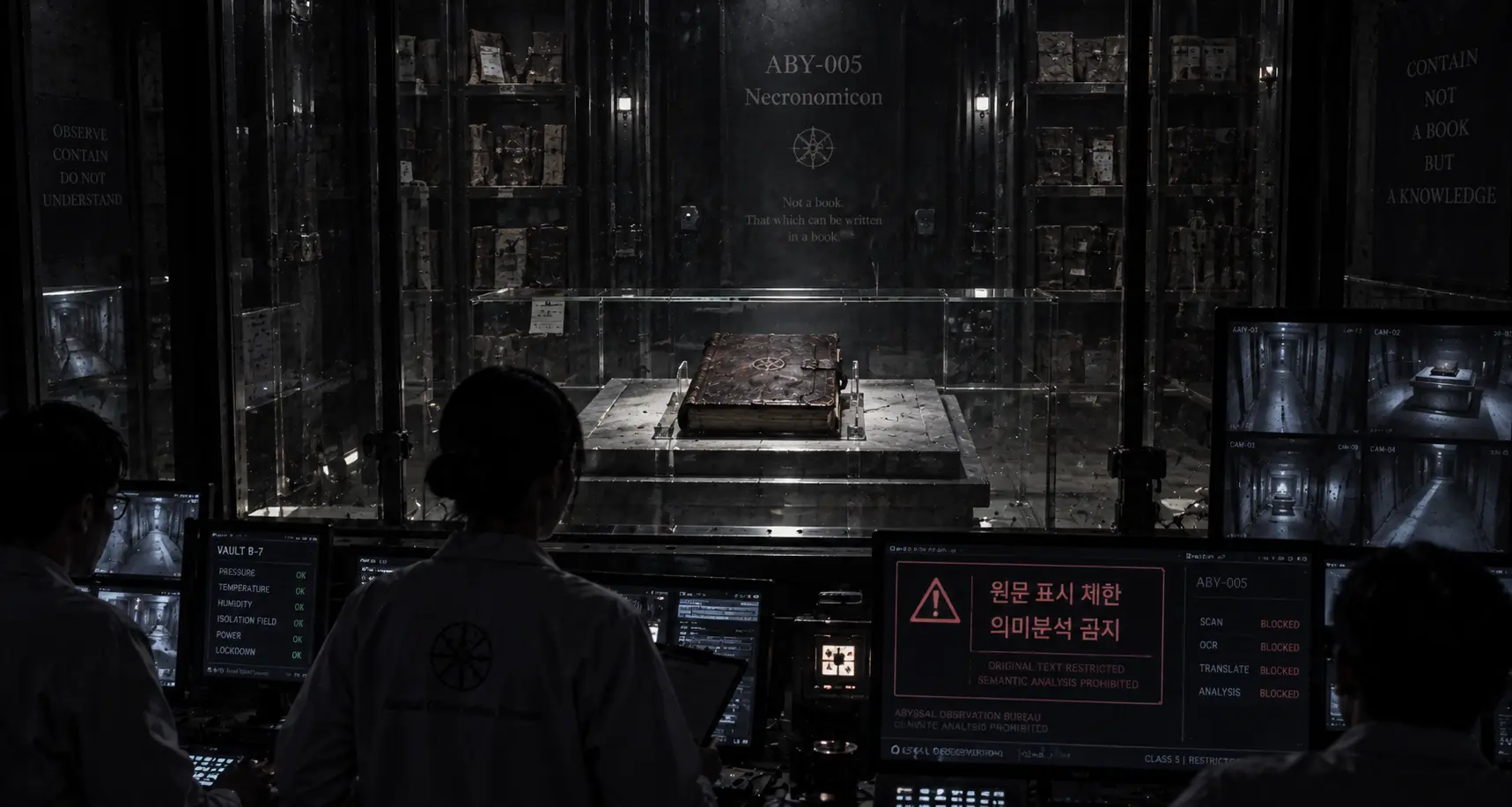
ABY-005 — Necronomicon
At first, the Bureau believed ABY-005 was—
a book.
It was wrong.
Recovered editions do not match.
They differ in size.
Material.
Language.
Page count.
A sentence present in one edition may be completely absent from another.
Two books believed to contain translations of the same material may arrange entire sections in different orders.
More troubling still—
when a damaged section from one edition is compared against another, researchers have occasionally reconstructed sentences that appear to have existed—
in neither original.
The Bureau therefore no longer treats ABY-005 as a single physical book.
Its current internal classification is closer to—
a recurring structure of knowledge capable of appearing across multiple media.
The Records Division's definition is deliberately simple:
ABY-005 is not a book.
It is something that can be written into one.
The Text Itself Is Not the Hazard
ABY-005 is not a conventional visual cognitohazard.
Seeing a page does not immediately kill or incapacitate the reader.
Individuals unable to read the relevant language have stared at pages for extended periods without developing observable symptoms.
On the other hand—
people who never saw the original text have developed anomalies after reading only—
an accurate translation.
For that reason, early procedures focusing exclusively on contact with the original manuscript were abandoned.
The Bureau no longer considers the letters themselves to be the primary hazard.
The danger appears to be—
understanding what they mean.
Certain information within ABY-005 appears to require several disconnected passages before it becomes complete.
The Records Division calls these structures Threshold Passages.
A Threshold Passage is not necessarily a single sentence.
It may consist of—
something read near the beginning,
an explanation dozens of pages later,
a diagram from an unrelated section,
and the translation of a single phrase.
Separately, they may produce nothing.
But when those pieces connect inside the reader's mind—
the anomaly may begin.
That is why different people do not react at the same page.
One reader reaches page thirty.
Another develops symptoms after a single paragraph.
And some—
never read the book at all.
They merely heard someone explain it.
Does Closing the Book End It?
No.
At least—
not always.
The most common early symptom is insomnia.
Then recurring dreams.
The sound of pages turning in an empty room.
A voice reading quietly from somewhere just beside the bed.
And after a certain point—
the symptoms stop appearing to have anything to do with books.
A person discovers a staircase in a building they have known for years.
Another insists there is an extra door at the end of a familiar corridor.
Someone becomes certain there is a room behind a solid wall.
Architectural plans do not convince them otherwise.
Instead, they say:
“The plans are wrong.”
The Bureau considers the next stage significantly more dangerous.
Because eventually—
the exposed person tries to—
open the door.
Why Copying It Is Prohibited
Early recovery teams attempted to digitize ABY-005.
At the time, the decision was entirely reasonable.
Old manuscripts deteriorate.
Ink fades.
Paper decays.
The obvious solution was to scan the original and allow researchers to work from copies.
With ABY-005—
that was almost the worst thing they could have done.
A physical book can be locked in one room.
A digital file cannot.
But simple reproduction was not the greatest danger.
During digitization, researchers naturally tried to improve the text.
Restore damaged letters.
Correct unclear phrases.
Compare alternate editions.
Translate difficult passages.
Fill in missing sections.
And in doing so—
they could create an ABY-005 that was easier to understand than the original.
The incident that proved this became—
ABY-005-A.
Incident Record ABY-005-A | The People Who Restored a Page That Never Existed
2016 / Central Europe / University Manuscript Conservation Facility
At the time of the incident, the manuscript had not been registered as an ABY object.
The university was digitizing several Latin manuscripts donated from a private collection.
One volume was severely damaged.
No title on the cover.
No author.
First and final leaves missing.
Multiple pages damaged by moisture and fire.
The research team initially believed it to be a late medieval or early modern work dealing with religion or astrology.
The work was routine.
Photography.
OCR.
Text correction.
Translation.
Comparison against other manuscripts.
The incident began after one researcher said:
“I think I've seen this passage in another book.”
The Missing Sections of Two Different Books Matched
The team located a similar passage in a manuscript digitized by another library.
The books did not share a title.
They were not dated to the same period.
Their page arrangements were different.
But when the damaged passages were placed side by side—
the gaps aligned almost perfectly.
Where ink had vanished from Edition A, Edition B preserved the words.
Where Edition B had been torn, Edition A continued the sentence.
The researchers concluded that the two manuscripts descended from a common source.
So they began reconstructing it.
Two editions.
OCR data.
Latin dictionaries.
Contextual inference.
Automated text correction.
The reconstruction worked.
Too well.
A paragraph that did not exist in complete form in either manuscript—
existed perfectly in the digital file.
“This Isn't an Incantation.”
Researcher E, a specialist in Latin, was the first person to translate the reconstructed paragraph.
He stared at the screen for several minutes before calling a colleague over.
An internal meeting recording preserves the conversation.
“Something's wrong.”
“What?”
“I thought it was a ritual at first.”
“Isn't it?”
Silence.
Then E said:
“This isn't a method for opening a door.”
“What is it?”
E continued:
“It's an explanation of why the door is already open.”
Approximately eighteen minutes later—
E stopped translating.
That night—
he could not sleep.
The First Door Appeared
The following morning, E stopped several employees in the basement.
“Where does that door lead?”
There was no door.
The staff initially assumed he was joking.
E became angry.
He pointed at a specific section of concrete wall.
“It's right there.”
He walked toward it.
Raised his right hand as though grasping a handle.
His hand struck solid concrete.
E appeared confused.
Then said:
“It's still not aligned.”
He refused to explain what was not aligned.
The Symptoms Spread
E had not been the only person to see the translation.
A total of twelve researchers viewed some or all of the reconstructed material during the editing process.
Within forty-eight hours—
seven developed similar sleep disturbances.
Five repeatedly drew nearly identical diagrams.
Four reported seeing nonexistent doors or passages inside the facility.
The disturbing part was not merely that they saw them.
It was that the locations they identified were—
almost identical.
The exposed researchers claimed they had never discussed their symptoms with one another.
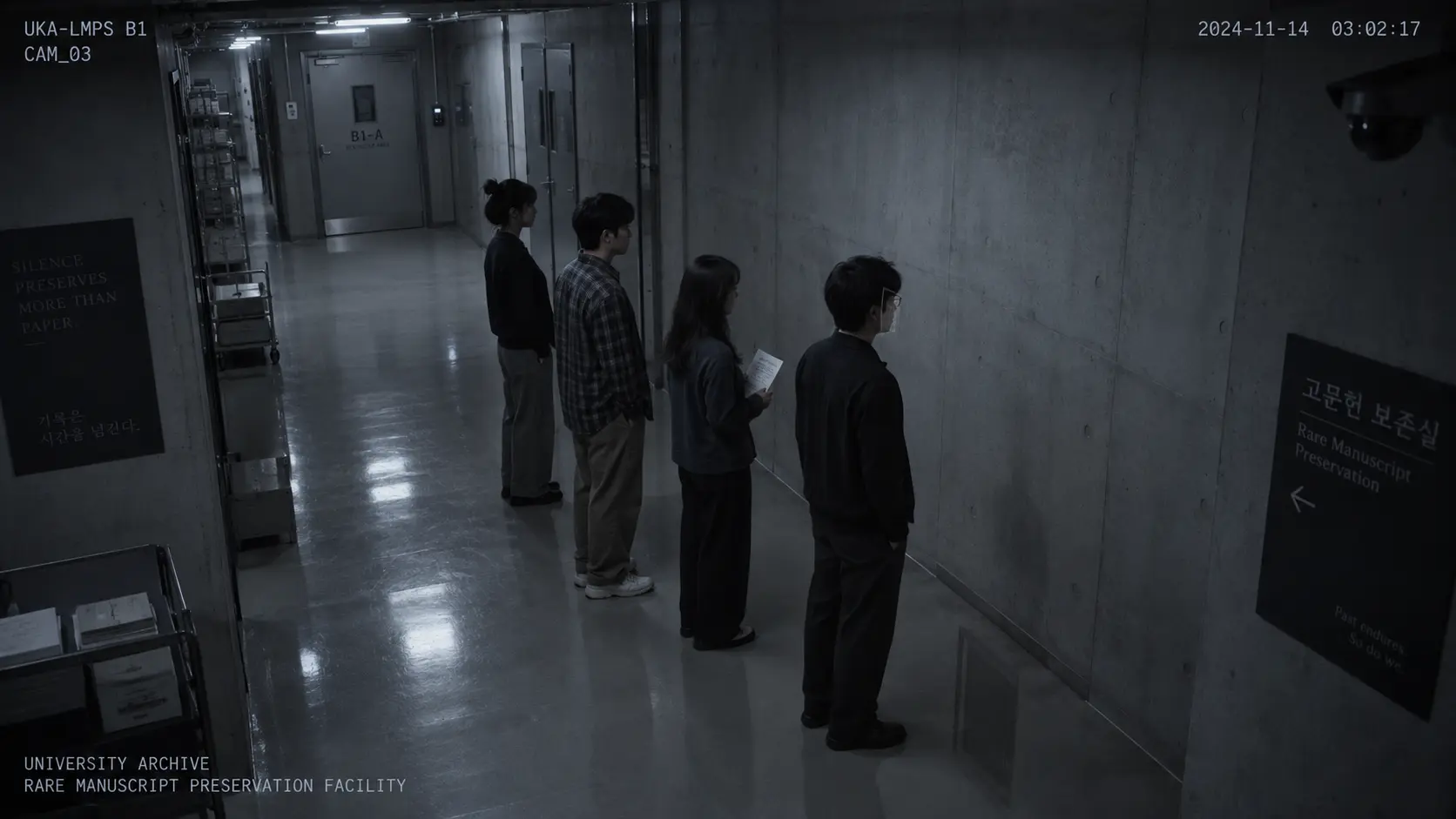
A security officer reviewing CCTV footage found something worse.
Every morning before dawn—
several researchers stood in front of the same blank wall.
They faced the concrete—
like people waiting in line for a door to open.
03:22 — One of Them Walked Through the Wall
Third day of the incident.
Exposed subject F entered the basement.
CCTV recorded F walking to the end of an empty corridor.
F stopped in front of the wall.
Raised the left hand.
Turned the wrist—
as though opening a door.
Then—
took one step forward.
No door opened on the recording.
The wall did not change.
There is no frame in which F's body makes contact with the concrete.
In one frame—
F is standing in front of the wall.
In the next—
F is gone.
No exit-camera record.
No exterior footage.
No body.
F has never been recovered.
The facility was closed later that morning.
The incident was transferred to the Abyss Observation Bureau.
The Bureau Made the Same Mistake
During the initial investigation, the Records Division attached portions of the translated material to an internal report in order to identify the exposure source.
The original text was redacted.
The sentences were summarized.
The report was therefore considered safe.
Two days later, an analyst who had read it asked:
“Was there always a door in the basement?”
The analyst had never seen the original manuscript.
The analyst could not read Latin.
The only exposure had been—
the Bureau's own summary.
The report was recalled immediately.
From that point onward, the Bureau changed how it defined ABY-005.
The original text was not the hazard.
Neither was translation by itself.
It was not a particular font.
Not a symbol.
Not even a specific physical manuscript.
The hazard was—
the meaning.
Does Deleting It Make You Safe?
The Bureau destroyed files connected to the incident.
Some exposed individuals continued to experience symptoms.
They saw the door without seeing the book.
Some claimed they could no longer remember the translation—
yet reproduced complete sentences while half asleep.
One exposed individual insisted all memory of the text was gone.
When handed a blank sheet of paper—
they wrote four lines in a language they claimed not to understand.
A passage believed to carry the same meaning was later found in another ABY-005 edition.
It therefore remains unconfirmed whether—
memory erasure,
file deletion,
or destruction of physical copies
can remove information once it has been sufficiently understood.
Once comprehension reaches a certain point—
destroying the book may not remove what is already inside the reader.
Response Certainty | Conditional
ABY-005 presents two very different response profiles:
before exposure—
and after it.
Preventive procedures appear comparatively effective.
Do not read continuously.
Do not reconstruct missing meaning.
Do not compare editions.
Do not produce complete translations.
Very few ABY-005-related cognitive anomalies have been recorded among personnel who follow those restrictions.
But once sufficient semantic comprehension has already occurred—
the situation changes.
Stopping may not stop the symptoms.
Destroying the text may not end them.
The person may be unable to describe what they learned—
and still continue anomalous behavior.
For that reason, Response Certainty remains—
Conditional.
The best response to ABY-005 is not learning how to survive after reading it.
It is never understanding enough in the first place.
Contact Protocol Rev. 4
Revised following ABY-005-A and the internal summary-exposure incident
Complete reading of ABY-005 source material is prohibited.
OCR, automated reconstruction, machine translation, and edition merging are prohibited.
Missing sections from separate editions must not be compared by the same individual.
Reports concerning hazardous passages must record symptoms and outcomes—not reconstruct the source meaning.
Exposed individuals must not be asked to reproduce remembered content.
Exposed individuals must be separated to prevent comparison or completion of partial information.
If a person reports nonexistent architecture, do not approach the indicated location for the purpose of verifying it.
If an exposed individual says, “I understand now,” do not ask what they mean.
Park Do-hyeon, head of the Containment Engineering Team, added a final sentence:
“Black bars don't make the meaning disappear.”
ABY-005 documents have since been subjected to stronger semantic redaction than any ordinary anomaly record.
Current Management Status | Conditional Containment
The Bureau currently holds multiple physical editions and fragments believed to contain ABY-005.
It does not assume that every edition has been recovered.
Possible material may still remain in—
private libraries,
personal collections,
religious or esoteric archives,
unclassified historical manuscripts,
and digital repositories.
Recovered editions are distributed across the Fifth Restricted Archive rather than stored as a single collection.
Access privileges are divided so that no individual researcher can read a continuous body of material.
Page images and page-order information are stored separately.
Personnel responsible for checking the physical condition of a manuscript do not analyze its contents.
Researchers studying the contents receive only the minimum fragments required.
The Bureau is not trying to protect a book.
It is trying to—
prevent the sentences from becoming one complete meaning again.
What Is Actually Written in the Necronomicon?
The Bureau does not provide a complete answer.
Not because it cannot.
Because—
it should not.
Confirmed material appears to contain descriptions of beings believed to predate human civilization,
places not connected to ordinary space,
abnormal explanations of life and death,
and procedures apparently intended to establish contact with certain entities.
Some passages resemble anomalies already known to the Bureau.
Others correspond to nothing currently registered.
The problem is that the Bureau cannot reliably determine whether these passages are—
fiction,
records,
prophecy,
ritual—
or something else entirely.
Some appear to be nothing more than descriptions.
Yet people who fully understand them begin experiencing spatial anomalies.
Seo Yu-jin summarized the problem during one internal meeting:
“First we need to determine whether this book records dangerous knowledge—”
“or whether the act of recording that knowledge is what makes something happen.”
The Bureau has not yet determined which explanation is correct.
Lumi's Field Notes
After ABY-005 received formal registration, Lumi appeared inside the restricted archive.
Lumi had never been granted access.
Security systems recorded no entry.
When personnel discovered the small black cat inside the containment room—
Lumi was not reading.
The Necronomicon remained closed.
Lumi simply sat in front of it—
looking at the cover.
An officer asked:
“Aren't you going to open it?”
“No.”
“Because it's dangerous?”
“Probably.”
“Do you know what's inside?”
“Some of it.”
“Then why don't you check?”
Lumi looked at the closed book for a moment.
Then said:
“Do you really have to know everything you don't know?”
The officer stopped asking questions.

The following is reproduced from Lumi's submission:
I don't think the book itself is scary.
It just sits there.
Open it—
it stays still.
Close it—
it stays still.
The problem is the person reading it.
Whenever you see something strange,
you always try to understand it.
If you can't read the letters,
you translate them.
If something is missing,
you fill it in.
If two parts don't match,
you make them fit.
And sometimes—
you make things fit that were never supposed to fit together.
Was the door those people saw real?
I don't know.
If it was real,
I don't know where it goes.
If it wasn't real,
I don't know how someone disappeared through it.
That's why I didn't open it.
Not the book.
The door.
...
You keep asking
what's written in the Necronomicon.
I think that's a strange question too.
You keep saying the contents are dangerous.
So why do you want to know so badly?
— Lumi
Seo Yu-jin asked one final question.
“Are there things even you don't know?”
Lumi answered immediately.
“Lots.”
“Don't you want to know?”
“Of course I'm curious.”
“And you're still not going to read it?”
Lumi pointed toward the closed book with its tail.
“Being curious and having to read it aren't the same thing.”
Lumi never opened ABY-005 that day.
Records Left in the Real World
※ From this point onward, the discussion concerns real literary and publication history rather than the fictional setting of Codex of the Abyss.
Despite the enduring rumors surrounding it, the Necronomicon is not an ancient occult manuscript.
It is a fictional book created by American horror writer H. P. Lovecraft.
The name Necronomicon first appears in Lovecraft's story “The Hound,” written in 1922.
There, the book is associated with the fictional writer Abdul Alhazred, an Arab poet portrayed within Lovecraft's fiction as possessing forbidden ancient knowledge.
Alhazred himself appeared slightly earlier.
In “The Nameless City,” written in 1921, Lovecraft refers to him as a mysterious poet familiar with ancient and disturbing truths.
Lovecraft later developed him into the fictional author of the Necronomicon.
In 1927, Lovecraft wrote the short pseudo-historical text “History of the Necronomicon.”
Within that fictional chronology, the book was originally titled Al Azif and supposedly written by Abdul Alhazred in Damascus around the year 730.
The invented history then describes a Greek translation around 950, when the title Necronomicon was supposedly adopted, followed by a Latin translation in 1228.
These dates are not historical facts.
They are part of the deliberately fabricated documentary history Lovecraft created for his fictional book.
Lovecraft also made the book's fictional nature clear in his correspondence.
He explained that the Necronomicon, Alhazred, and the surrounding mythology were his inventions, and that creating an elaborate publishing history helped make the stories feel more convincing.
A handwritten manuscript of Lovecraft's “History of the Necronomicon” is preserved by Brown University's John Hay Library.
The fictional book later became an important connective device across Lovecraft's stories.
One especially relevant example is “The Dunwich Horror.”
That story features a Latin edition held at Miskatonic University as well as an incomplete English translation.
Wilbur Whateley attempts to compare different versions in order to recover specific passages and ritual information.
In other words, the Necronomicon was not used merely as ominous set dressing.
Lovecraft increasingly treated it as—
a text through which dangerous knowledge could actually be transmitted.
There are also real commercial books that have been published under the title Necronomicon.
But none of them is the ancient manuscript described in Lovecraft's fiction.
From the 1970s onward, imitation editions, occult publications, and commercial versions helped strengthen the misconception that Lovecraft's fictional grimoire might have been based on a real historical book.
It was not.
What makes the Necronomicon remarkable is not that it was a genuine spellbook.
It is that Lovecraft gave his fictional text—
an author,
an original title,
translators,
different editions,
a censorship history,
and fictional library holdings.
He constructed the sort of bibliographic history normally associated with real historical manuscripts.
So when readers encountered the Necronomicon beside actual books and historical references in his fiction—
for a moment, they could wonder:
“Was this book real?”
That is the element expanded in Codex of the Abyss.
Different editions exist.
Translations are made.
Pages are lost.
Scholars reconstruct missing sections.
But the anomaly is no longer merely—
a dangerous physical book.
It is—
knowledge that survives translation, fragmentation, reconstruction, and transmission—and becomes more dangerous the closer someone comes to understanding it completely.
Abyss Record Summary
ABY-005 | Necronomicon
| Chapter | Chapter V: Forbidden |
| Classification | Infohazard · Ritual-Mediating Forbidden Text |
| Threat Level | Deep |
| Management Status | Conditional Containment |
| Response Certainty | Conditional |
| Manifestation Conditions | Not applicable |
| Activation Conditions | Cognitive + Action-Based, suspected |
| Primary Risk | Semantic comprehension · Edition comparison · Translation · Reconstruction · Knowledge transmission |
| Primary Avoidance Rule | Do not read continuously or reconstruct missing context |
| Primary Contact Rule | Stop reading · Do not reproduce content · Prevent exposed individuals from comparing information |
| Special Directives | No complete reproduction · No OCR · No recitation |
ABY-005-A | The People Who Restored a Page That Never Existed
A paragraph absent in complete form from every known source edition was created during digital reconstruction.
Confirmed exposed individuals:
12
Sleep-related abnormalities:
7
Spatial-perception abnormalities:
4
Missing:
1
The most important confirmed conclusion is:
The original text is not the only hazard.
A sufficiently accurate translation or summary may become hazardous if it leads to the same meaning.
Containment therefore does not end when the books are locked away.
The fragments must not be allowed to become one complete meaning again.
And once a person has already understood enough—
there is currently no established procedure capable of reliably stopping what follows.
Key Note from Lumi
“If you can't read the letters, you translate them. If something is missing, you fill it in. Sometimes you make things fit that were never supposed to fit together.”
If you cannot find a way to survive the encounter, find a way to avoid it.
With ABY-005, the Bureau uses a different version:
If you cannot find a way to forget after understanding—do not understand in the first place.
END OF RECORD.


