Myth & Folklore-Based Fiction Archive | Historical traditions and sources are explained in the later section.
If You Called Her Name and Nothing Appeared, Do Not Check Another Mirror
Codex of the Abyss — Chapter I: The Dead | Record 035
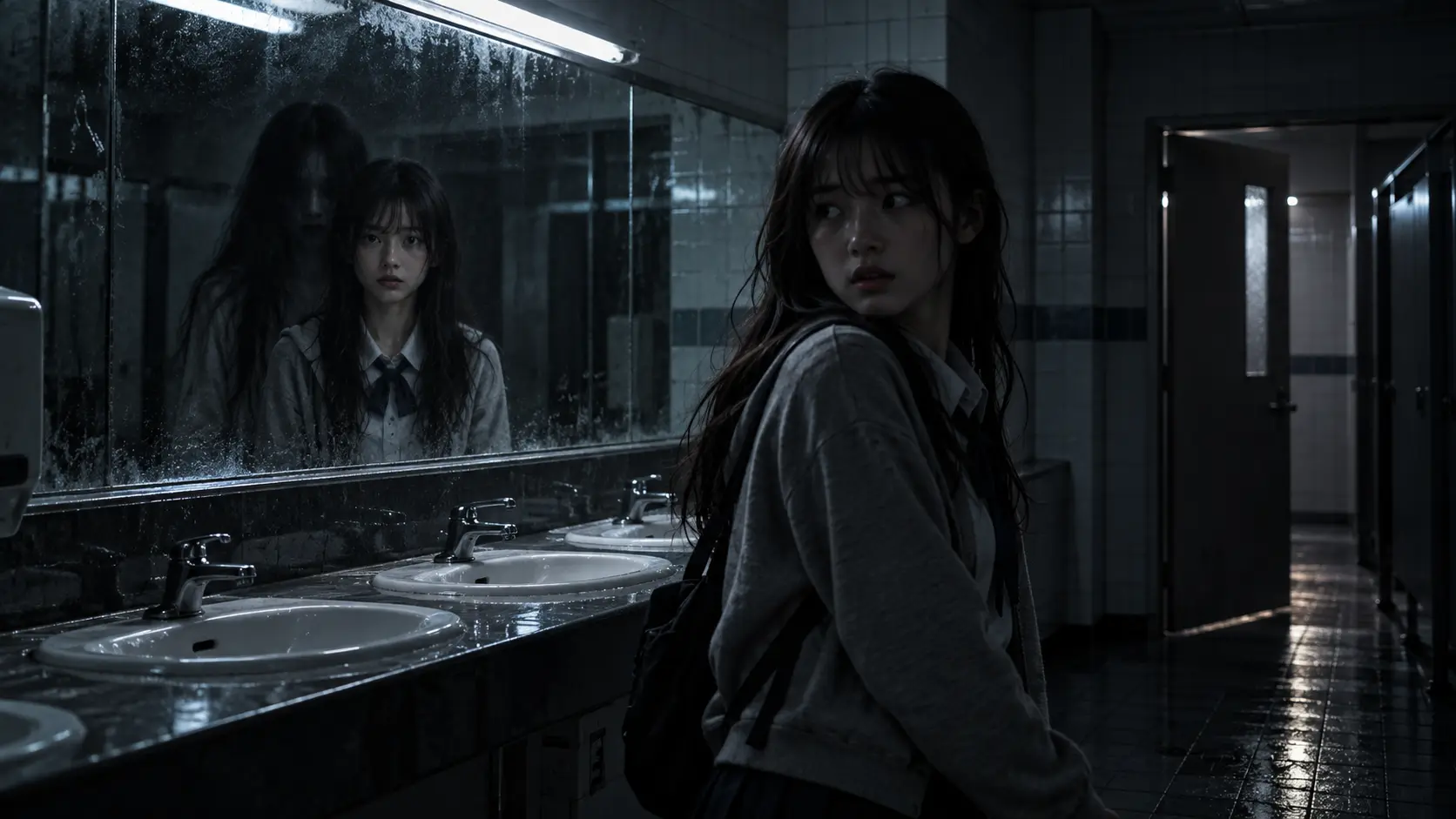
| Record No. | ABY-035 |
| Designation | Bloody Mary |
| Chapter | Chapter I: The Dead |
| Classification | Mirror-Invocation · Reflection-Manifestation Dead |
| Threat Level | Depth |
| Management Status | Active Tracking |
| Response Certainty | Conditional |
| Known Population | Whether all manifestations are the same entity remains unconfirmed |
| Primary Traits | Manifestation through mirrors · delayed reflections · mimicry of caller's appearance · closer approach after repeated observation |
| Manifestation Conditions | Invocation-Based · Cognitive |
| Primary Domain | The Second Look |
| Special Directives | No repeated invocation · Do not verify using another reflective surface · Do not repeatedly photograph anomalous reflections |
| Recorder | Lumi |
Contact Warning
The Bureau has not confirmed the popular rule that Bloody Mary will always appear after her name is spoken exactly three times.
Some accounts use five repetitions. Others use thirteen. Still others use far more.
Candles appear in some versions and are completely absent in others.
The common factor identified by the Bureau is not the number.
Someone stands in a dark place and looks into a mirror. The name is repeated.
Then—
they look again to see whether something actually appeared.
ABY-035 activity frequently becomes stronger after this second look.
If you attempt the ritual and see nothing—
do not find another mirror to make sure.
ABY-035 — Bloody Mary
ABY-035 is a female-presenting Dead phenomenon that manifests through mirrors and other reflective surfaces.
Witnesses commonly describe long hair, a pale face, damaged-looking skin, or an appearance suggestive of blood. None of these features are consistent enough to serve as identifiers.
The face is more unusual.
In early reports, witnesses consistently described the figure as:
a woman they did not know.
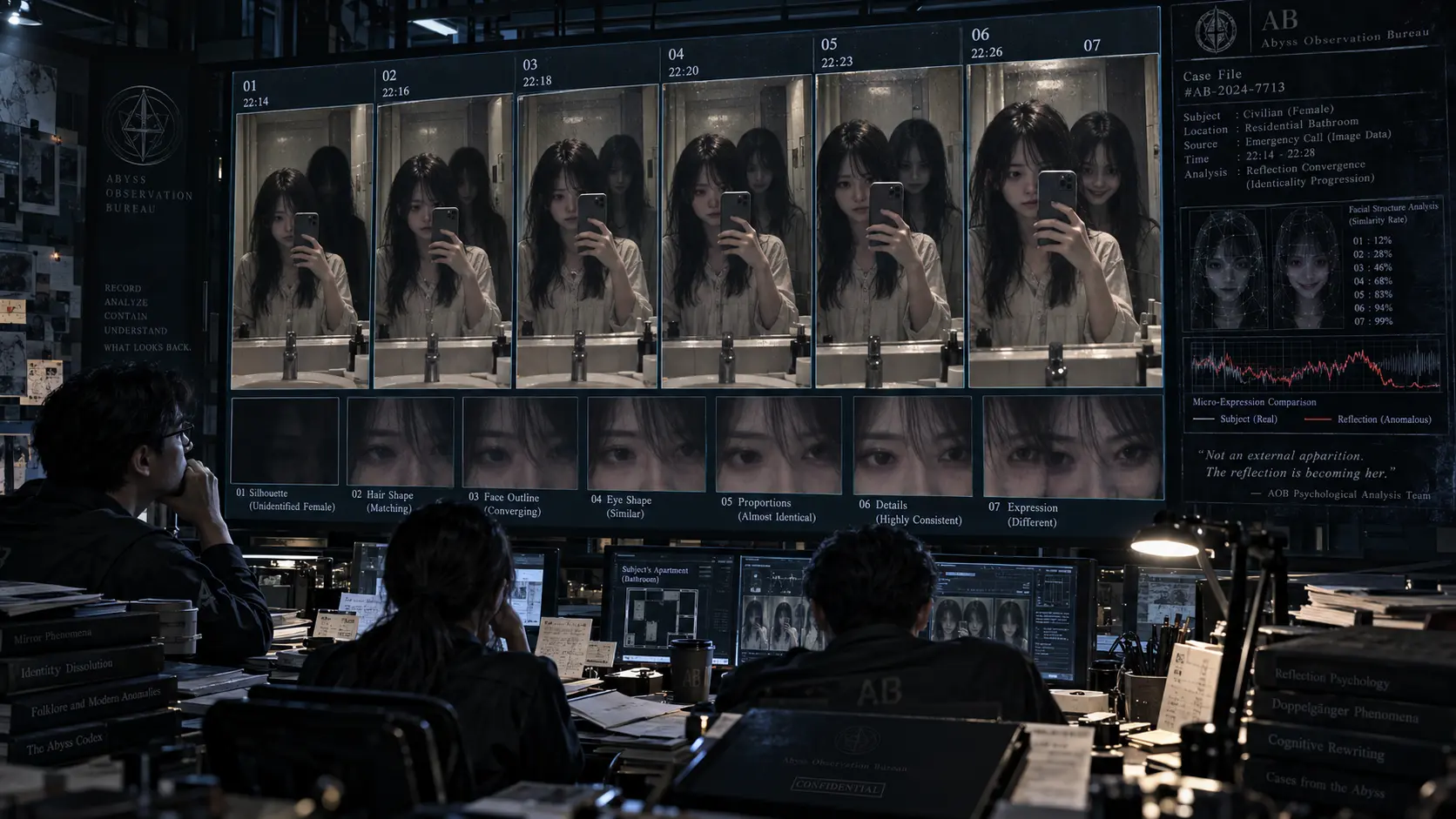
After the Bureau began conducting image analysis, another possibility emerged.
The distance between the eyes.
The jawline.
The length of the nose.
Facial proportions.
In repeated-contact cases—
these features partially matched those of the caller.
The similarity appeared to increase with continued observation.
The Bureau therefore cannot confirm that Bloody Mary possesses—
a fixed face of her own.
Is the Woman in the Mirror Standing Behind You?
Usually not.
Witnesses often report seeing a woman standing behind them in the mirror.
A camera recording the physical room at the same moment frequently shows—
no one.
They turn around.
Nothing is there.
They look back at the mirror—
and she is closer.
For this reason, turning around is not specifically prohibited under ABY-035 protocol.
It is simply discouraged.
The danger may not be the act of looking behind you.
The danger is what people almost always do next:
look into the mirror again.
ABY-035 does not appear to close physical distance in ordinary space.
It appears to approach the caller's position—
inside the reflection.
Domain | The Second Look
After ABY-035 activates, anomalous effects may continue not only in the mirror used for the original invocation, but in other reflective surfaces deliberately used by the caller to check their own appearance.
The Bureau records this Domain as:
The Second Look
| Domain Name | The Second Look |
| Primary Domain Type | Cognitive Domain · Overlapping Domain |
| Secondary Traits | Observation-Reactive · Perception Contamination |
| Unique Trait | Reflection Substitution — provisional classification |
| Primary Signs | Delayed reflection · mismatched gaze · imitation of caller's appearance · migration between reflective surfaces |
| Threat Level | Depth |
| Exit Method | Cases show weakening after deliberate self-reflection is discontinued |
| Bureau Response | Cover reflective surfaces · limit caller's observation behavior · isolate in a non-reflective environment |
Reflection Substitution refers to the gradual convergence between the caller's reflected image and ABY-035.
At first, it appears as an unfamiliar woman standing behind the caller.
Then the color of her clothing begins to match.
The length of her hair changes.
Eventually—
the two faces become difficult to distinguish.
The Bureau has not confirmed what occurs after that stage.
It has no intention of doing so.
Incident Record ABY-035-A | Nothing Happened After the Third Call
2026 / Illinois, United States / Educational Facility
Four students attempted a Bloody Mary game in a school bathroom after classes ended.
One phone was used to record the session.
The lights were switched off.
“Bloody Mary.”
Three times.
Nothing unusual happened for approximately twenty seconds.
The students laughed and left the bathroom.
Up to that point—
it appeared to be an ordinary game.
The problem began when they watched the recording again.
In the final two seconds of the video, Student H turned away from the mirror.
The real H moved toward the right side of the frame.
But—
H's reflection remained still for approximately one second.
Then the reflection looked toward the camera.
They Checked Again
The students replayed the footage several times.
H returned to the bathroom and checked the mirror.
Nothing.
After going home, H checked the bathroom mirror.
This time—
a woman was visible behind H's right shoulder.
H turned around.
No one was there.
When H looked into the mirror again—
the woman was standing directly behind them.
Later that night, H messaged the other students.
“Her face looks like mine.”
The others assumed it was a joke.
H began taking photographs.
And with each new image—
the woman's face changed.
It Was Becoming H
H's guardian eventually contacted authorities after finding H repeatedly checking mirrors, the dark screen of a switched-off television, and the black screen of a phone throughout the night.
When Bureau personnel arrived, H was sitting on the bathroom floor.
The mirror had been covered with a towel.
H said:
“I didn't cover it.”
The guardian had.
Han Seo-jin asked:
“Where was she the last time you saw her?”
“Behind me.”
“How close?”
H did not answer immediately.
Then:
“I don't think she was behind me anymore.”
Han paused.
“Then where was she?”
H answered:
“In my place.”
The Final Photograph
H's phone contained thirty-one photographs of reflective surfaces.
In the first image, there was little similarity between the unknown woman's face and H's.
In the final image—
most major facial landmarks overlapped.
The only clear difference was expression.
H was crying.
The H inside the photograph—
was smiling.
Park Do-hyeon immediately confiscated the phone and covered its screen with opaque film.
The mirrors inside the house were not destroyed.
They were covered.
H was transferred to a temporary observation room with no windows and no reflective surfaces.
Only one instruction was given.
Do not check your own face.
The Bureau Did Nothing
The Bureau did not attempt to invoke Bloody Mary again.
The original mirror was not brought into containment for testing.
Her name was not repeated to determine whether she would respond.
H spent approximately nine hours without intentionally viewing any reflective surface.
The anomalous sensations gradually diminished.
Fourteen hours later, a small metal mirror was exposed for approximately one second.
Normal reflection.
No further abnormality.
H survived.
No physical injuries were recorded.
After this incident, an older Bureau instruction—
“Do not complete the invocation count.”
was revised.
The current directive is:
If anomalous activity is suspected after an invocation, do not repeatedly check whether anything happened.
The third repetition of the name may not be the most important moment.
The first deliberate look afterward—
may matter more.
Can Bloody Mary Be Classified as a Dead Human?
Current classification remains:
Chapter I: The Dead
But—
her identity has never been confirmed.
There is no evidence that ABY-035 is the ghost of a specific historical woman named Mary.
There is also insufficient evidence that the same entity appears in every incident.
Because the face and behavior can change between callers, some researchers in the Records Analysis Division have proposed reconsidering the Dead classification entirely.
Seo Yu-jin wrote:
“We have not yet determined whether a dead woman appears in the mirror, or whether we call whatever appears in the mirror a dead woman.”
Current classification:
Maintained
Reassessment pending additional incidents.
Avoidance and Current Response
ABY-035 contact is extremely unlikely without deliberate invocation.
For that reason, the Bureau does not attempt to suppress Bloody Mary games among civilians.
Most attempts produce nothing anomalous.
If delayed reflections, mismatched gaze direction, or reflections of people who are not physically present appear immediately after an invocation—
protocol changes.
Do not check another mirror.
Do not repeatedly photograph the reflection with a phone.
Do not continue enlarging video frames to compare faces.
Do not break the mirror.
Cover it.
And when the urge arises to check whether the phenomenon has ended—
do not look again.
Lumi's Field Notes
Lumi entered the school bathroom H had used.
She sat in front of the mirror.
Nothing happened.
Lee Do-yoon asked:
“You're not going to say the name?”
“Why?”
“So she'll come out.”
Lumi looked at him.
“We didn't come here to make her come out.”
A little later, Lumi looked into the mirror.
“Humans always look again when they see something strange.”
Lee answered:
“Because you have to make sure.”
“You already saw it once.”
“You might have seen it wrong.”
Lumi turned toward him.
“So you look again.”
She thought for a moment, then wrote one sentence in her notebook.
“From the second time you look, the thing on the other side might already know you're going to look again.”
After that—
Lumi showed no further interest in the mirror.
Records Left in the Real World
From this section onward, the discussion concerns actual Bloody Mary folklore and related scholarship rather than the fictional setting of Codex of the Abyss.
Is Bloody Mary a Real Mirror Folklore Game?
Yes.
Bloody Mary is a well-documented form of children's and adolescent folklore, particularly in the United States.
Folklorist Alan Dundes published the article “Bloody Mary in the Mirror: A Ritual Reflection of Pre-Pubescent Anxiety” in Western Folklore in 1998.
The article examines multiple versions of a ritual in which participants stand before a mirror, often in a dark bathroom, repeat Mary's name, and expect a frightening figure to appear.
One detail is especially important:
There is no single fixed version of the ritual.
Today, repeating the name three times is probably the best-known version.
Older collected accounts also include names such as Mary Worth and Mary Jane, with much higher repetition counts.
School bathrooms, dark household bathrooms, candles, and other conditions vary considerably between locations and storytellers.
The USC Digital Folklore Archives likewise contains different versions of Mary Worth and Bloody Mary games.
Therefore—
“You must say Bloody Mary exactly three times because that is the original rule”
is not historically reliable.
Is Bloody Mary Queen Mary I of England?
The two are frequently connected.
That does not make the identification certain.
Mary I of England became widely associated with the nickname “Bloody Mary” because of the execution of Protestants during her reign.
But no reliable continuous tradition has been established connecting Mary I directly to the modern mirror-invocation game.
Those are two separate claims:
Mary I was a real historical monarch associated with the nickname Bloody Mary.
And:
The Bloody Mary summoned in the mirror is Mary I.
The first can be discussed historically.
The second has not been established.
Other names, including Mary Worth and Mary Whales, also appear in the folklore.
Attempting to force every Bloody Mary story back to one historical woman should therefore be treated cautiously.
Mirror Divination Is Older
Mirror-related customs existed long before the modern Bloody Mary game.
The Library of Congress has discussed Halloween practices from the late nineteenth and early twentieth centuries in which young people used mirrors to try to see the face of a future spouse.
Candles, darkened rooms, mirrors, and the expectation of seeing a face that should not yet be visible create obvious similarities with later mirror folklore.
However—
similarity is not proof of direct descent.
There is a difference between saying:
“Older mirror-divination traditions existed.”
and:
“Those traditions directly became Bloody Mary.”
The available material supports the first statement far more securely than the second.
Is Alan Dundes's Interpretation the Final Answer?
No.
Dundes interpreted the Bloody Mary ritual in relation to anxieties experienced by pre-pubescent girls, particularly concerns surrounding bodily change.
The title of his article explicitly reflects that interpretation.
It remains an influential and interesting folkloric analysis.
It should not, however, be treated as the single proven meaning behind every performance of the game.
Other perspectives can emphasize group fear, tests of courage, ritualized play, or the social experience of performing frightening games together at night.
Codex of the Abyss does not use Dundes's interpretation as an actual supernatural rule for ABY-035.
Historical Tradition and Codex Expansion
Historical folklore supports several core elements: darkened rooms, mirrors, repeated names, variations including Mary Worth and Bloody Mary, the expectation that a frightening female figure may appear in the mirror, and substantial variation in invocation rules between regions and generations.
The following elements are original expansions created for Codex of the Abyss: delayed reflections, ABY-035 gradually adopting the caller's facial features after repeated observation, the Domain The Second Look, the provisional Reflection Substitution trait, Incident ABY-035-A, and the Bureau protocol of stopping deliberate self-reflection rather than attempting further invocation.
The central question of this record is simple.
If an unfamiliar woman appears in your mirror—
is the frightening part that she is getting closer?
Or—
that she is becoming harder to distinguish from you?
References & Sources
Alan Dundes, “Bloody Mary in the Mirror: A Ritual Reflection of Pre-Pubescent Anxiety,” Western Folklore 57 (1998), pp. 119–135.
An influential folkloric study examining multiple versions of the Bloody Mary mirror ritual and Dundes's interpretation of the practice.
JSTOR — Bloody Mary in the Mirror
USC Digital Folklore Archives, “Childhood Game – Bloody Mary / Mary Worth.”
A digital folklore collection containing examples of Bloody Mary and related Mary Worth mirror-game traditions.
USC Digital Folklore Archives
Library of Congress, “Century-old Tricks for Finding Your True Love on Halloween.”
A Library of Congress article discussing older Halloween mirror-divination customs involving attempts to see a future spouse's face.
Library of Congress
Abyss Record Summary
ABY-035 | Bloody Mary
Chapter: Chapter I: The Dead
Threat Level: Depth
Management Status: Active Tracking
Response Certainty: Conditional
The Bureau has not confirmed an exact number of invocations required to activate ABY-035.
The stronger pattern appears to involve something else.
After the first anomaly—
repeated attempts to verify what was seen may strengthen the phenomenon.
ABY-035 may also lack a fixed face.
The more frequently the caller checks the reflection—
the more closely the figure may resemble them.
One question remains unresolved.
Is Bloody Mary copying the caller's appearance?
Or—
is the caller's reflection itself becoming Bloody Mary?
Lumi's final note:
“From the second time you look, the thing on the other side might already know you're going to look again.”
Even if you want to make sure—
do not look again.
END OF RECORD.


